
Et in Arcadia
A Vignette

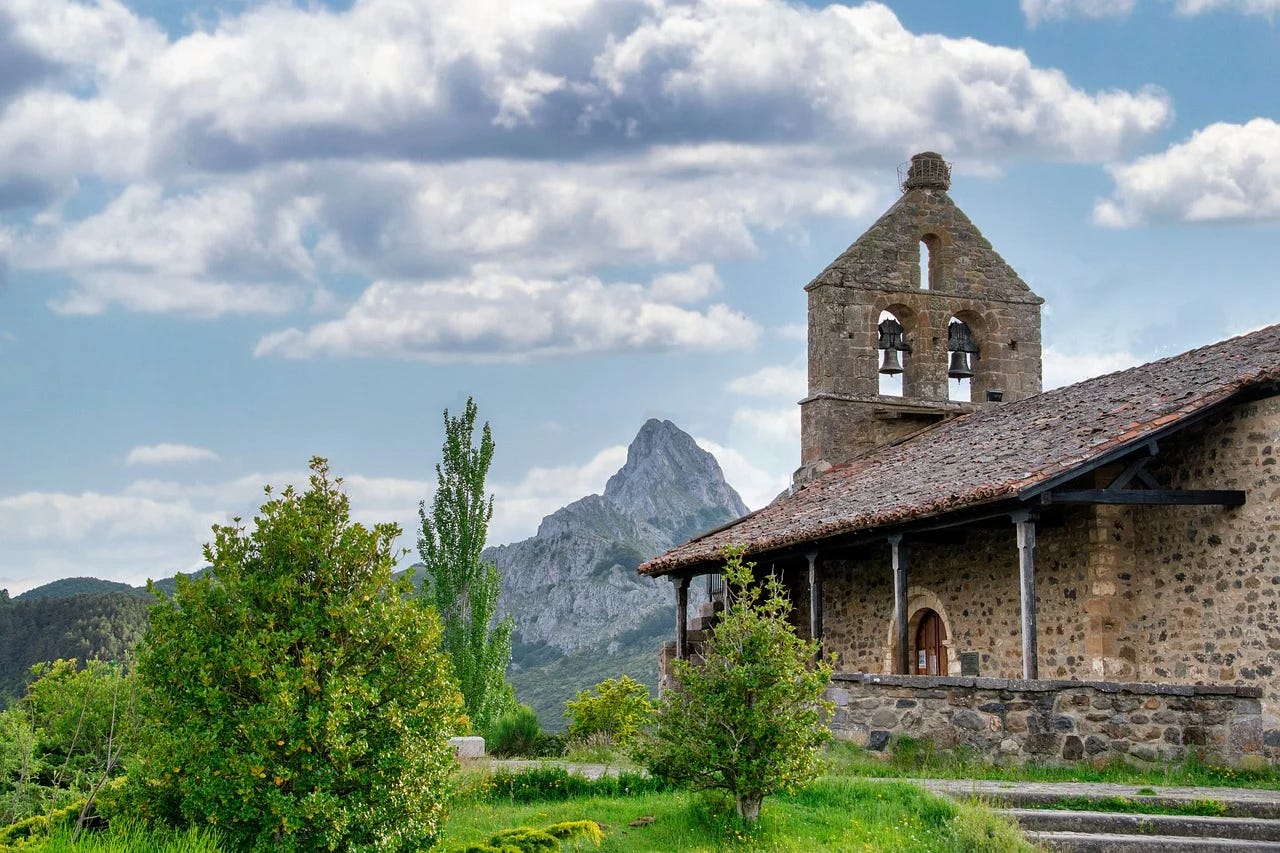
Written to this visual prompt for the writing group I lead.
The bells were as much a part of the day as the songs of the ever-present larks, background sound not consciously heard. They rang for early Mass, bringing the women of the village out; they rang for the liturgical hours, for evening Mass, for births and deaths, baptisms and funerals. They had been ringing now insistently, unceasingly, as they only rang when something of importance demanded everyone gather at the stone church at the centre of their lives.
The last time had been the death of a king.
This time, he knew it was war.
Rumours had been swirling for days, weeks, ripples of conversation among men who met at taverns and crossroads, at markets and out on the high pastures where the sheep and cattle grazed. Like flotsam in a wide river, stories true and false travelled along the high road, every inn adding or subtracting to the tales, and at every crossroad that took a traveller to a village or distant farm, the stories travelled too. On Sunday mornings the priests sometimes denounced the stories as lies, the work of the devil stirring up discontent and fear.
One of the bells had been badly cast; it rang off-key, discordant. An insult to the harmony of God and the angels, the last priest had said, and asked for offerings to replace it. The new priest had laughed, saying God loved the imperfect, and the bell had served for the last hundred years and would serve another hundred. The coins in their strongbox would be used for food and fuel for the poorest among them, when the winter winds blew.
There’d be a greater need this coming winter, with the men away to war.
He thought, sometimes, up here in the high pastures with the larks singing all around him, that the old priest had seen him as an insult to God too. If man was made in God’s image, then what was he, with his withered arm? He wasn’t like the men who’d been born whole, their twisted hips or missing fingers the results of accidents. He’d come from the womb this way. Lambs did too, sometimes, one leg shrivelled and useless. He’d been spared their fate, but he wondered what might have happened had he been born in a hungry year.
The note of the badly-made bell didn’t travel like the others. Here, far distant from the church, he heard it as a break in the rhythmic chiming, as if the air had swallowed the sound. The old priest had believed in perfection, seen in the imperfect world an insult to his God. But how could that be? God had made the world, and if it was damaged, marred, then He’d directed it to be so. The music of creation wasn’t harmonious. It was interrupted, broken, by bells that rang off-key; by shrivelled arms and winter hunger. By the death of kings and the birth of wars.
No army would want him. Even though he could ride, and throw a spear at wolves, and with one good arm and a crook rescue mired lambs or fallen ewes. The sheep trusted him, looked to him and his dogs for protection, up here where the air was cold and the pastures green, far from the minds of kings and the waste of war.
Up here, sheep would always need a shepherd, and the larks would always sing.
has a moral steadiness and calm authority
Whole lot of interesting details in such a short passage. This was a lot of fun to wonder about.