
In the Wilderness
I would starve to death before I reached the coast, I concluded.

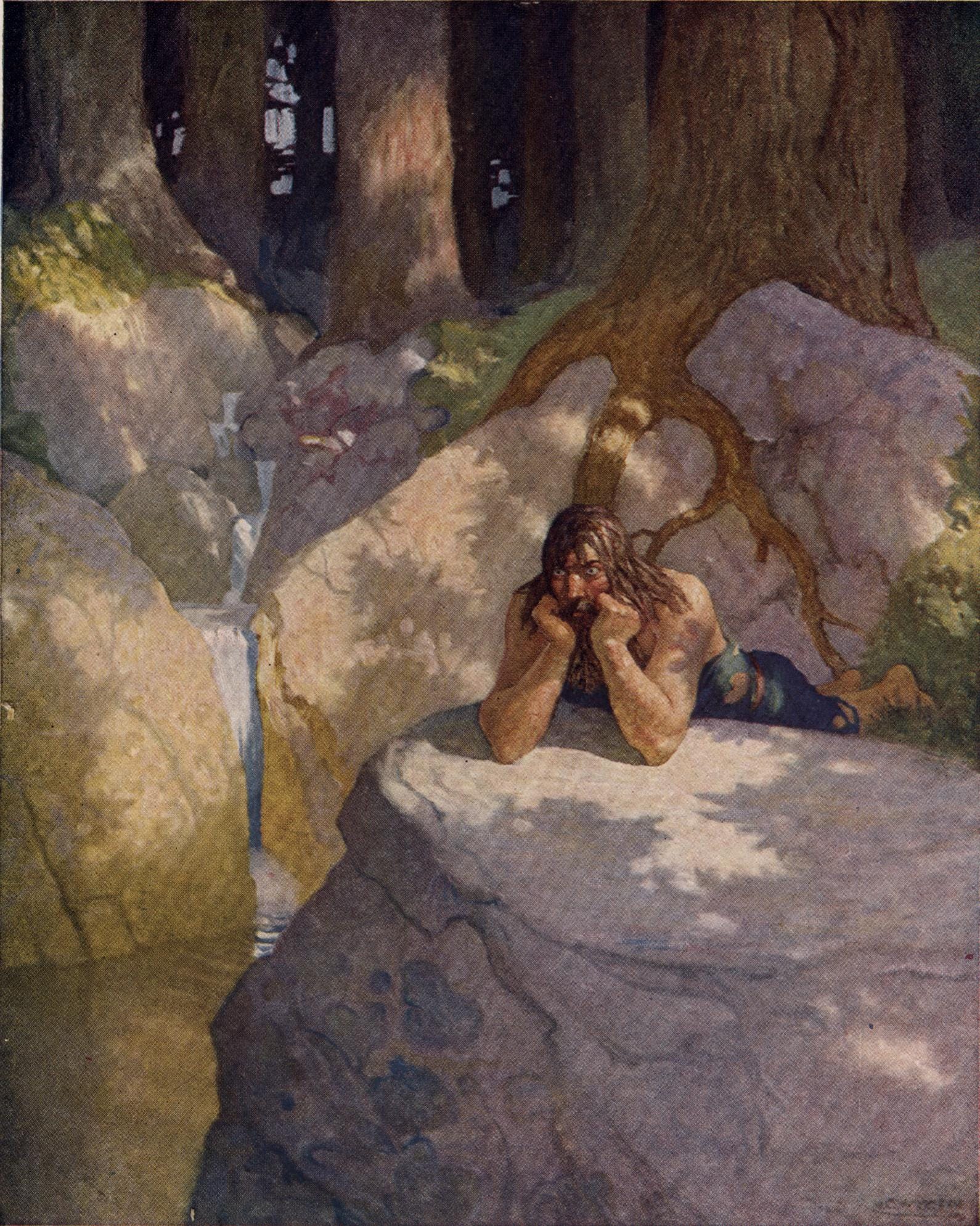
Just prior to this scene (which has been slightly edited to be a coherent stand-alone story) the narrator, who is travelling alone in a forest on a secret task for his country’s leader, has been attacked and left for dead by two trappers.
Cold woke me, cold and pain. I was alive. For now. Shivering, I moved each limb. Nothing broken, as far as I could tell. I tried to sit up. That hurt, terribly, my gut and lower back and sides exploding. I lay down again and examined my torso with my hands. No blood. I hadn't been stabbed. I held my breath, and sat up again. It seemed more manageable this time.
I propped myself up until the throbbing in my abdomen eased, looking around. Daylight filtered through the mesh of evergreen branches. Above me, the ground sloped upward. They'd thrown or pushed me down the scarp to the west of the trail, leaving me to die.
A violent shiver ran through me. I must move, I thought. I need a fire. My pack might still be up there, or a few coals in the fire ring. My legs felt colder than the rest of me, my breeches clammy. I felt them: wet, and when I brought my hand near my face I could smell urine, the tang sharp in my nostrils. I'd pissed myself.
But, no. My crotch was dry. I gagged when I realized what they'd done. I fought down the impulse to retch: it hurt too much. I collapsed back onto the earth, tears seeping from my eyes. Sobbing took energy I didn't have. I can't get up there, I thought. Just go back to sleep. Dying of exposure is supposed to be kind.
Swearing, I pushed myself up again, moaning, and began to crawl. I passed out at least once more, but much later I dragged myself over the lip of the scarp and onto the trail. I used the boulders to help me to my knees. Scattered around the campsite, my belongings had been smashed and fouled, and my cloak and what food I had had was gone. Fire, I told myself. Make a fire.
I searched the campsite on my hands and knees, finding first my flint, and then, at the base of a tree, my steel. Deep in the fire ring a few coals held some warmth, and those and the sparks from my flint were enough to make dried needles catch, and then twigs.
I shook with exhaustion and hunger and pain. The bones of the squirrel lay in the dirt. I rinsed them in the stream, filled my kettle to just below the split in its side, and threw them in. I set the kettle on the fire. A few mushrooms grew along a fallen log. I added those, hoping I recognized them correctly as edible.
The thin broth revived me a little, enough to give me strength to gather what of my things were worth keeping. My tent had been slashed, long rents making it useless except as a ground cloth. I spread it out as best I could. I had had one change of clothes: my attackers had taken a knife to those, too, so I simply put the rags on over what I wore. Then I pulled the tatters of blanket over me, cushioned my head on the folded pack, and fell into a fitful sleep.
I woke to add wood to the fire, and to relieve myself, a burning stream of urine that made me gasp in pain, then slept again until morning. When I woke again, I felt better. Not well, but better. I could think. I sat up, the strips of blanket around my shoulders. My stomach spasmed with hunger. I needed to eat, but first I added twigs to the fire, blowing on it as best my ribs — cracked at the least, I thought — would allow.
Food. I couldn’t hunt; the pain in my ribs prohibited it. I looked at the stream, a memory stirring. Had I seen the silver flash of a fish last night? I followed the burn eastward, and found a pool worn into the rock of the hillside, and in that pool, fish. Perhaps I could fashion a hook from thorns or a sharp piece of twig. But these were little fish. From a tangle of bushes, I picked a red berry, dropping it in the pool. Fish swarmed to it. I grabbed one, wincing at the pain even that quick motion caused. But I had a fish.
I realized I needed to scoop the fish out when they came to the berries, not try to catch individuals. A remarkably short time later, my left side throbbing, I had a meal. I gutted them, laying the bodies on the coals of the fire, flipping them over with a twig. The first two I swallowed half-cooked.
For the next two days I ate fish and berries and mushrooms, and even mice that came nosing around for what tiny bits I dropped. I slept a lot, my body demanding it, but on the third morning I woke with a strong sense that I needed to leave. If there had been one trapping party out here, there could be others.
I still hurt, but when I relieved myself my urine looked yellow, the red tinge of the last two days gone. Standing made the world swirl and spin. I sat down, hard, my ribs screaming: it was that or fall. I waited for the dizziness to pass, my head bent. After some minutes, I turned my neck gingerly, assessing the effect. Under ferns to my left, I saw the glint of metal.
I edged over, reaching out. My knife! They hadn’t bothered to search for it, I realized, thinking they were leaving me for dead. With a knife, I had a chance. I pulled myself to my feet. With difficulty, I cut a walking stick, whittling one end into a dull point to dig into the ground. Resting every few minutes, fighting light-headedness, it took me most of the morning to pack up.
I'd forced myself to smoke some of the fish I'd caught, not eat it, so I had a little food, and the low-growing blue berries that clambered over stumps and fallen trees were plentiful. I ate some, and a few fish, and then I lifted my pack onto my shoulders, gasping at the pain, and began, very slowly, to walk north.
I doubt I made it more than a mile or two that afternoon, before fatigue and pain made me stop. My sleep was broken, and my dreams fragmentary and frightening, engendering strange and powerful thoughts.
For perhaps a week I made my painful way north along the trail, travelling only a few miles each day. I suppose my body healed, but I was constantly hungry and light-headed, and the insistent fear of discovery meant I slept badly, adding to my disorientation. I thought there were voices once, and hid, shaking and dry-mouthed, behind a fallen trunk, only to realize after some time that what I had heard was the cawing of crows. At night by my fire, I recited poems to myself, under my breath, just for the comfort of it.
Early one morning, just as I rounded a bend in the trail, I saw a marten on the trunk of a tree ahead of me, a squirrel in its mouth. Without thinking, I threw my walking stick at it. The stick bounced harmlessly off the tree, but to my surprise the marten dropped the squirrel, flowing up the trunk to challenge me from a branch. I picked up the walking stick, and keeping an eye on the marten, reached for the squirrel, still warm.
Well away from the marten, I gutted the squirrel, and at the next appropriate spot I built a fire and cooked it. The smell of it roasting! But I waited, although my hunger overruled prudence, and I ate it all. After enough to eat—at least for my shrunken stomach—for the first time since I had been attacked, I sat, considering my situation.
I would starve to death before I reached the coast, I concluded. Already I was gaunt, my clothes loose. But what options did I have? I couldn't hunt; I'd tried throwing the knife, and the pain in my ribs made an accurate throw impossible. Berries and water weren't going to keep me alive.
Water. The streams ran down off the mountains. To where? I closed my eyes, trying to remember maps. Wasn’t there a river? I became convinced there was. I got up and went to the edge of the trail, looking down the scarp, my walking stick well planted. I could see nothing: no glint of water, and certainly no path down.
Food had sharpened my mind. In my condition — possibly in any condition — trying to climb down the scarp without a path was folly. But if trappers and hunters came up from the lowland farmsteads, then there should be trails. Had I passed one? I couldn't remember, but for days I had walked with my eyes only seeing the path immediately in front of me.
In the lowlands I could not likely hide from other people. But it was my only chance of survival.
I found the descending trail the next day. It was steep and precarious, and I edged my way down with the help of the walking stick. It took me hours, sometimes clinging on to trees for several minutes before attempting a step. At one almost-vertical drop I stopped, convinced I would fall if I continued, and after many minutes I sat down and scrambled and slid down the rocks. Tears of pain and fatigue wet my cheeks by the time I reached the bottom, where the river I had correctly remembered ran between the scarp and the rolling plain beyond.
Reedmace grew along its bank. Reedmace roots were edible, even raw. I dug my hands into the mud, pulling them up, rinsing each one in the flowing water before I ate it, although I tasted mud regardless. My stomach full, I found a sheltered place along the bank, wrapped myself in my tatters of tent and blanket, and slept.
This excerpt from Empire’s Reckoning has little of history behind it except the setting, modelled on the once-vast Caledonian Forest of Scotland. But it has an older story underpinning it, the story of Lancelot, sent away by Guinevere, wandering mad and lost in the forest. (The choice of picture to illustrate this piece wasn’t random.) Sorley, the narrator here, is also part of a love triangle, although in my book he leaves by choice after learning what Cillian, the man he loves, has done — a betrayal of a different sort — and knowing that by doing so, he will never again be welcomed by Lena, the woman who is both his closest friend and Cillian’s wife. Faint echoes of the Arthurian story cycle can be found throughout the Empire’s Legacy series: this is the most obvious.
Find all my books here.
Check out some interesting free downloads in a variety of genres here. It includes A Divided Duty, an introduction to the main character of my first trilogy and the fictional early-medieval/late-classical world of the books.