
Pride
This man could have been his enemy. Now they were brothers in arms.

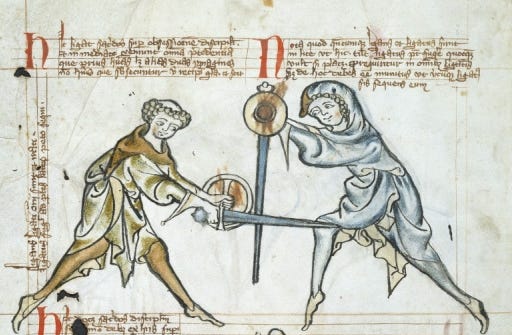
An excerpt from the work in progress, An Unwise Prince, set in the same fictional world as my previous series, but about 500 years later.
The last thing Rothgar had expected was — flowers. Fields full of them, mostly yellow but with purple and white ones scattered throughout, and, in the distance, wooded hills. Tahir ab’Hatim, standing beside him on the deck of the ship, grinned at his surprise. “You were expecting a desert?”
“I was,” Rothgar admitted.
Tahir gestured. “Beyond the hills. Walk south for two days, less. First the land is simply dry and hard, and then it becomes a sea of sand, stretching far in all directions.” He glanced at Rothgar. “There is no escape that way.”
“No chance of the Temülchid approaching from the south, then.” Rothgar accepted the warning without reacting. It wasn’t for him, anyhow, but for the men sitting on the deck, wrists and ankles bound. Some sat with heads bowed, in despair or defeat. Some were looking around, varying degrees of interest showing on their faces.
They’d worked their way south, down through Odïrya nearly to the Trakïyani border, taking captives from farms and small hamlets, avoiding any settlement where eight men might be outnumbered. Then west through Tisaris, along a river that passed through a steep-sided mountain gorge, and out to the sea. They hadn’t taken men in Tisaris, but neither had they been stopped, not even at the port at the river’s mouth. Bribes had been paid, he assumed. At the port, Ab’Hatim had gone ashore with two of his men, returning with barrels of water and baskets of bread, oval and flat.
In the crossing of the Nivéan Sea they’d lost two of the captives: a boy of perhaps thirteen and his brother. The lights of an island had been visible, fires flickering. Without a word the boy had scrambled to his feet and jumped into the dark waters. His brother had gone after him before anyone could stop him. Tahir had sworn, loudly, but he hadn’t ordered the ship turned, and after that the men weren’t just bound at wrists and ankles, but roped together. At night, not sleeping, Rothgar thought about the two of them, about desperation and love and pride, and the death they’d chosen over an unknown future. He didn’t have it in him to do that, not while his sword and his wits had a decent chance of keeping him alive. A different sort of pride.
Anyhow, he hated the Temülchid, and in the back of his mind he had a plan. Not one he’d shared, not even with Andric, yet. Nor would he, until this southern branch of his enemy had been driven back and contained – he had no illusions that they could be destroyed – and a solid peace in place. However long that took.
From the tidal marsh beside them, a huge bird took to wing, its flight a slow undulation. A heron, but twice the size of the ones Rothgar knew. Once or twice he’d been in the guard when Sambët’s duke had ridden out into the marshes to hunt herons and cranes with his gyrfalcons. Even those magnificent birds might have trouble with a heron like this one, he thought.
Ahead of them, where the marsh gave way to meadow and the flowers began, the riverbank was lined with landing stages, and beyond them, buildings the colour of dried mud, the roofs domed. A group of men waited. The ship glided in, the oarsmen slowing its momentum. Ropes were thrown. The ship settled against the wharf.
“Come. Just you.” Rothgar glanced back at Andric, standing guard at the stern. He held up one hand; Andric nodded. Tahir stepped smoothly from the ship, Rothgar less so. He felt the other men’s eyes on him.
A sharp question from one of them. A lined face, hair greying: not the tallest, but he held himself with authority, reinforced by the decorated bronze cuirass he wore. Tahir answered, with some deference. More words were exchanged, the older man scrutinizing Rothgar. His eyes went to Rothgar’s sword, sheathed at his side.
“You are here voluntarily?” His Casilan was accented, but not unduly.
“I am. My companion too.” Just about true; Andric had taken some convincing.
“Why?”
“The Temülchid razed my city. Killed my men, killed my duke, killed our families.”
“You were an officer? You have led men?”
“A captain. Trained and led, yes.” Rothgar kept his voice level.
“And your friend?”
“My sergeant.” Andric hadn’t been, but he’d need him in that role now.
The man said something to Tahir, who answered with what appeared to be agreement. Ab’Hatim turned to him. “Order the captives off the ship. In their own language. The commander wishes to see that you can speak to them.”
He could, just about. The languages of the Kidari and the Odïryani weren’t so different, and enough of the Kidari captives spoke Odïryan that his commands would be relayed even if his words weren’t clear. Rothgar nodded. “Where do you want them?”
He gave the order, adding his own warning: “You’re here to be soldiers. It’s not a bad life; you’ll be fed and housed. Don’t be idiots.” The men clambered off the ship, awkwardly, even with their ankle restraints loosened. Tahir had ordered that when they’d entered the marshes. They lined up along the wharf. Thirty-eight of them now, and Andric at their rear.
Rothgar watched as they left the ship, seeing who offered a hand to another, who looked around with interest, who stood with head bowed. And who met his eyes with burning hatred. Two of them: brothers, he thought, or maybe cousins, taken from the same farm. They’d been vocal on the ship, lashing out, until Tahir had tied their wrists behind their backs and gagged them. Sullenness had replaced the rebellion then, except when they looked at Rothgar or Andric. He’d have to harness that passion, or destroy it – and possibly them.
“Good. My men will take them to where there is food and water. Tell them, and tell your sergeant to go with them.”
Andric acknowledged the order with a hand to his chest. The captives shuffled off the wharf and up a path to the buildings, four soldiers and Andric with them. Rothgar waited.
“I am Faris ab’Arib. I command here,” the older man said. “You call me Kay’id. Why did the Temülchid defeat you?”
“Numbers. There were far too many of them.”
“There will always be too many of them,” ab’Arib said, almost scornfully. “You have seen this now. What would you do differently?”
He’d had quite a bit of time to think about this. “The horses. They are dependent on them to move the army, to move the supplies, to fight. I would target the horses, Kay’id.”
The commander nodded. “How?”
“In the army, more spears, more bows, weapons that can kill a horse from a distance. Surrounding the city, more ditches, more palisades, anything that makes the land difficult for a horseman. I would flood land, where it was possible, to create mires. But we did all these things. It wasn’t enough.”
“You did not consider enticing them into high land? It is also difficult for horses.”
“My city stood on low hills, above a river. The Temülchid broke down its walls with their catapults, then swam their horses across the river to finish us. But –” Rothgar laid a hand on the bank above the wharf. “Think of this as my city. Think of the wharf as the plain on the far side of the river. On that plain we grow grain and pasture animals. Had we known, had we had warning, maybe we could have moved the harvested grain and the animals west of the city, and burned the pastures and stubble, so the Temülchid horses had no grazing and the soldiers had no grain. It might have kept the force they sent against us smaller, and given us time to send for help.”
Ab’Arib nodded again. “You are a man who observes and thinks. Come. There is water to wash with, and food and drink, and then you will show me your skill with that sword.”
The food was more bread and olives, but also a soft goat cheese and a sweet, sticky dark fruit. Rothgar ate sparingly; he could deal with hunger, and he didn’t need a full stomach if he was going to have to engage in swordplay. The Kay’id asked more questions as they ate. How many would be needed to keep Sambët subdued?
“Not many,” Rothgar said.. “There is no one left to resist, or rise up against them.”
“Where will the army go, do you think?”
“North is possible, but the land is hilly and forested. South will be easier, along the river valley.”
“Bringing them down to the inland sea, where the southern army gathers,” Tahir said. Ab’Arib nodded.
“I fear so. We will need more men, if that is the case.” Tahir lifted a hand in acknowledgement. Ab’Arib turned back to Rothgar. “Tell me about their weapons.”
Rothgar described what he’d seen: the massive catapults, hurling boulders at the city walls, and weighted, flaming bundles that set buildings alight; the curved, deadly bows of the riders, and their swords, also curved, designed to slash down from horseback. “Some had spears, some axes,” he added.
“When I fought them twenty years ago, it was the same,” the Kay’id said. “That is good to know.” He dipped his fingers in a bowl of water, then wiped them with a cloth, signifying an end to the meal. “Now, show me what you can do with that sword.”
On flat ground behind the buildings, Rothgar faced his opponent. The Cyrennesi man was about his height and weight, and well muscled. He wore only light breeches, revealing a diagonal scar running across his chest. Rothgar stripped off his mail and the tunic beneath it, streaked with sweat and dirt. His own scars would tell the same story as his opponent’s, of battles survived. He wondered, briefly, who this man had fought.
“Do not draw blood,” the Kay’id instructed. The Cyrennesi raised his sword, the blade pointing to the sky. Like Rothgar’s, it was double-edged, straight; unlike his, the blade was inscribed with intricate patterns. On the periphery of the field, two groups of men watched: the captives, with their guards and Andric, and on the other side, another forty or so. His opponent’s cohort?
“I am Marad ab’Badr,” the Cyrennesi said, bringing his attention back to the moment. “May I know your name?”
“Rothgar Rurikson.” He too held his sword up.
Ab’Badr grinned. “Shall we dance?”
They were well matched, but ab’Badr hadn’t been confined to a ship for most of the last weeks. Rothgar felt his own clumsiness, the sword heavier than it should have been. Still, as they struck and parried, circling, the tightness in his muscles receded and the sword became again what it had been since he was sixteen, an extension of his arm, its movements and responses needing no conscious thought.
A long time since he’d fought without a shield, though, and a bare arm wasn’t useful in defending against a sword blow. He took several taps on his free arm and shoulder – ab’Badr careful to keep his blade flat – before he adjusted, angling his body the way his opponent was. Their blades hit, the sound of metal on metal resounding. Shouts of encouragement came from one side of the field. So they were ab’Badr’s men.
Rothgar stepped back, wiped sweat from his forehead. He grinned at ab’Badr, who grinned back, and then nodded. The dance began again. Swords met and separated, feet circled, dust puffing up, stinging eyes. Flat blades hit flesh, welts beginning to show on both men. Rothgar’s breathing deepened, his throat stinging. Distantly, he heard Andric shout encouragement. A few other voices seemed to come from that side of the field now. Another parry, and another – and then this time the angle was right and Rothgar slid his blade towards the hilt of ab’Badr’s, using all his strength to force the Cyrennesi’s sword down – then twisting his own up to touch ab’Badr’s stomach with its tip, at the spot where a thrust would pierce the liver and kill.
Ab’Badr laughed, stepping back. He bowed to Rothgar. “Well fought, Captain.”
Rothgar sucked air. Nodded. “And you – Captain?”
“Yes. My men, there.” He gestured with his chin, towards the men. “Yours, there. I have had mine ten days. We will train against each other, when yours are ready.”
He held out a hand. Rothgar took it. This man could have been his enemy. Now they were brothers in arms. It was the way of war and the world, in these times. No place for false pride here.
The history behind this story?
The enslavement of men from countries north of the inland sea known in our world as the Mediterranean, and in this one the Nivéan Sea, to fight for a people on its southern coast is loosely based on the creation of the Mamluk army. In the 9th century enslaved men from the Caucuses, the Balkans and southern/southeastern Europe, as well as those of Turkic origin, became the mainstay of the army of the Abbasid Caliphate of Egypt.
In the 13th and 14th century, the Mamluk army (by this time under the command of Mamluk emirs — who still continued the use of slave-soldiers) was instrumental in the defeat of the Mongol Ilkhanate army in Syria. In An Unwise Prince, the Mongol analogues are the Temülchid — and the enslaved army that Rothgar and Andric have become part of will be important in the fight against them, which should happen (I say should, because the trajectory of my books changes during the writing) in the sequel, A Distant Obligation.
For an earlier excerpt featuring Rothgar (who is one of five POV characters in An Unwise Prince), click here.
Find all my published books here.
You made this scene seem very real, dirty and sweaty.
I loved the development of the characters! If only it was a bit more like this in the world today.