
Ten Weeks
Week 7

Sunday March 22
At the start of the Nar valley walk, the rooks are noisy. Near Priory Farm, just north of where we’re parked, there’s a rookery in the trees. But there are three small nests, each meagre lattice of twigs showing gaps, in the electricity tower perhaps 400 meters from the trees. There are plenty of other trees, close to the main colony and further away. Why the tower? We’re guessing these are young birds, attempting breeding or even just nest-building for the first time, perhaps from the main rookery, perhaps from another.
Priory Farm is on the site of a Benedictine nunnery, and on the Ordnance Survey map the fish ponds are still marked, although traces of them are now difficult to see on aerial maps. Between Castle Acre and King’s Lynn, the valley of the Nar was home to many medieval religious houses, so many the 19th century writer and cleric Augustus Jessopp called it ‘Norfolk’s Holy Land’. A navigable river, water meadows, and landowners pleased to save their souls by granting land to the various religious orders all played a part in this. Some fell into disuse before Henry VIII’s destruction; many were dissolved then, the land sold and the buildings dismantled or repurposed to become farmhouses, barns, and stables.
A clear night meant the day began chilly, but spring sunshine soon brings warmth. On the male willow catkins, now spikily green with anthers, bumble bees are loading their legs with pollen. On the ponds, great crested grebes float in pairs. A kestrel hovers. Butterflies are out, too, dancing along the dykes that keep the Nar channelled, so quick I can’t get them in my binoculars to identify. Two mute swans float along the river; reed buntings dart in and out of the stands of bulrushes.
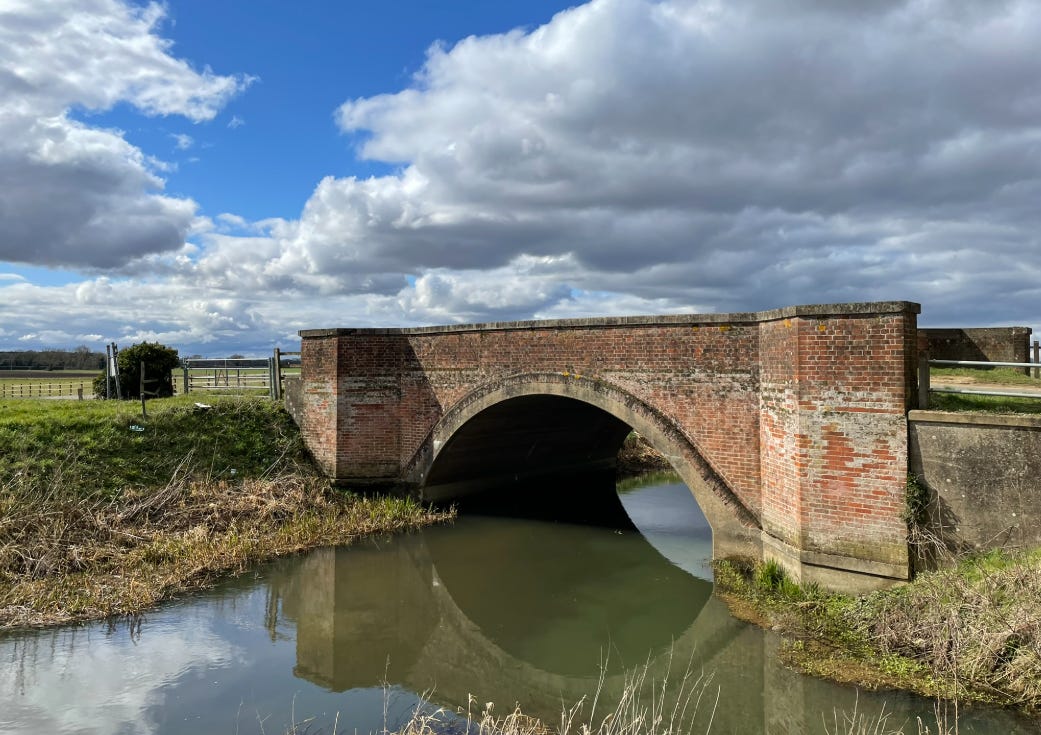
The walk takes nearly three pleasant hours, the background song changing as we move from riverside to woodland and back, but always present.
Back home I finish the short story set in York, and do both some contract editing and feedback to members of the writing group, in preparation for Tuesday’s meeting.
Monday March 23
At the edge of the village of Ringstead lies, in a steep-sided glacial valley, an area of chalk grassland that has never been ploughed or planted. We used to walk here quite often — it’s a Norfolk Wildlife Trust site — but somehow it fell out of our rotation of walks. Time to remedy that.
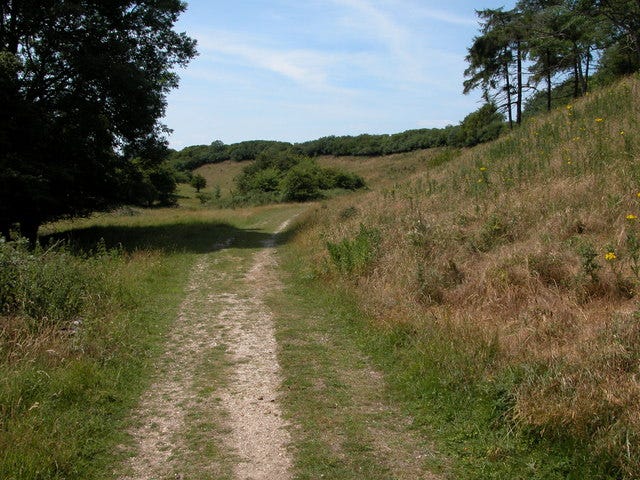
Near the beginning of the walk is a rehabilitated chalk pit, a project taken on by the village fifteen years ago. Paths wind in and out of trees and up and down some fairly steep slopes. The chalk was quarried to a significant depth, creating at its centre a sheltered bowl with high walls, grassed now and scattered with picnic tables and benches. Tits and blackbirds, chiff-chaffs and robins sing. It’s a lovely spot, and promising for later warblers. We’ll be back.
Twenty species of butterflies have been recorded in the NWT site, but there are only one or two out today. It’s early still, and cool, so that’s not a surprise. We walk to the end of the reserve and back. Buzzards and kites circle overhead; jackdaws chatter, wrens and a song thrush bubble.
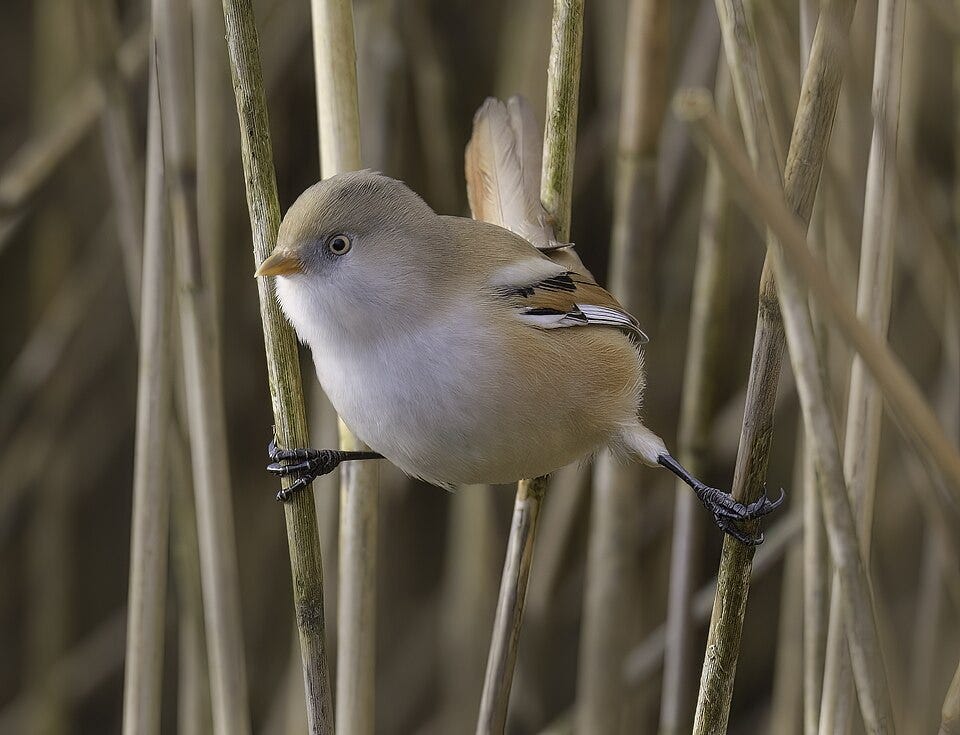
From Ringstead we drive to Titchwell. It’s warmer now, and sunny, and the parking lot is packed — but as usual the number of cars never seems to correlate to the number of people on the reserve. We walk along the footpath towards the sea. Just before Island hide, I catch sight of a silhouette in the reeds. The shape is right . . . yes! Bearded reedling, a female, posing nicely for just long enough to be seen well, and by both of us. Always elusive, always a delight.
Tuesday March 24
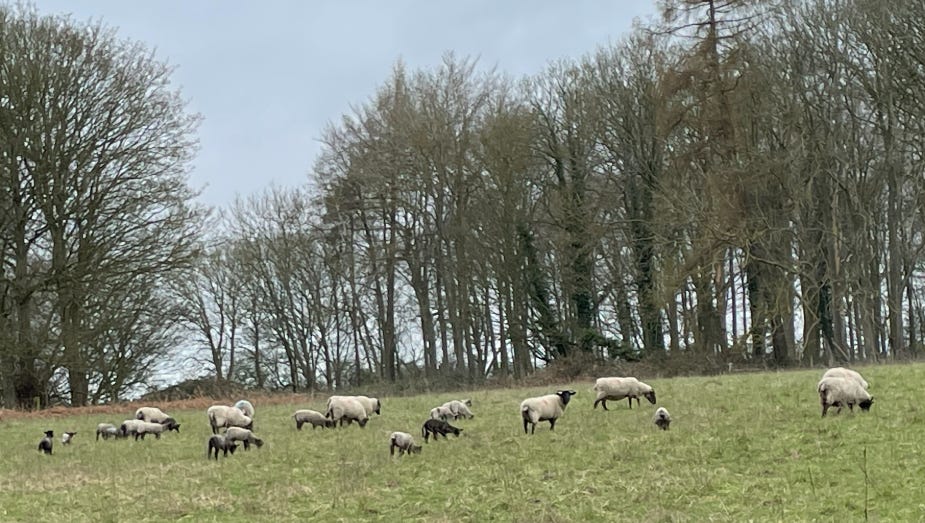
Strong winds today, so a sheltered walk: the Houghton estate. Where, as we come out of the first section of woodland onto pasture, there are lambs. The first of the year. Two are so tiny and unsteady they can’t be more than a day old. We are watched warily by one ewe, the mother of the newborns; the others ignore us completely.
A nuthatch calls, insistently, somewhere out of sight. A flock of thrushes crosses the sky above the trees and then descends: redwings, a surprise this late in March.
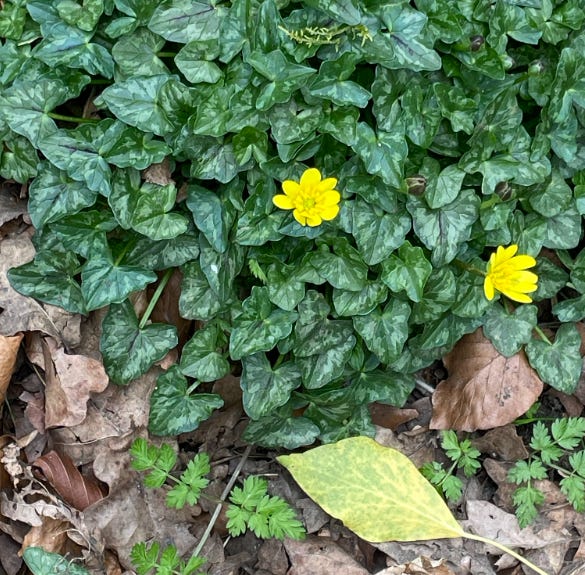
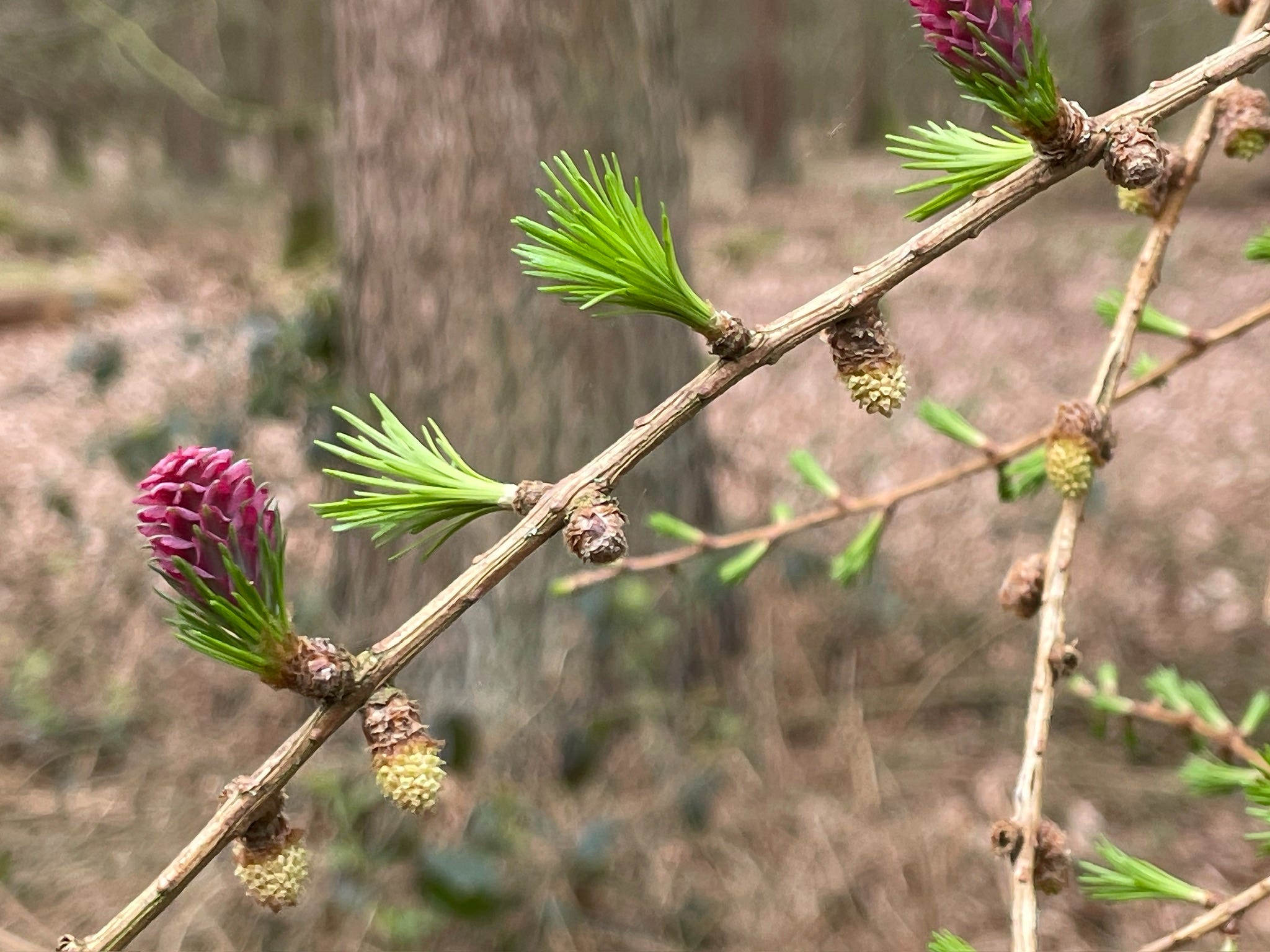
By the path lesser celandine is in bright flower, and there are patches of wooland violets, most purple, some almost-white. Larches are flowering, the cerise ‘larch roses’ of the female inflorescences bright in the sun.
I’m tackling a major piece of revision in An Unwise Prince over the next days: the elimination of a subplot. It needs to go: it’s a complication the story doesn’t need, but removing it means a fair bit of rewriting, as its reverberations are felt throughout the first half of the story. Two minor-but-important characters need to die, to put aspects of the major plot in motion, but how they die took the story too far away from its focus.
In writing group, there are poems and stories, fiction and non-fiction. I am in awe of this group — I know that sounds like a cliche — but the work they’re doing, most simply for the challenge and pleasure of creativity, deserves awe. Perhaps especially for the members who are in their eighties and nineties, continuing to push themselves to learn new prose or poetical forms and doing it well. They challenge me not only in my own writing, but in my teaching and critiques: they deserve the best I can give.
Wednesday March 25
Off to the lovely new King’s Lynn library to work on a windy Wednesday morning. The 9:35 bus is packed; I’ve never seen it this busy. But it’s a double-decker again, so I climb up to the top floor and enjoy the view on the roughly half-hour trip. The sun winks in and out, creating shadow patterns on the fields, and for a very few minutes, it rains.
After lunch Brian meets me at the Majestic; we’re here to see Mother’s Pride, which is another ‘community bands together to save X’ plot, X this time being a village pub. Predictable but amusing. Outside afterwards, it’s supposed to be raining, but is instead brilliantly sunny.
Thursday March 26
Yesterday was a break from walking; today is a break from the laptop. I go to Ely without it (but not without a notebook!) I need thinking time, to figure out two plot problems.
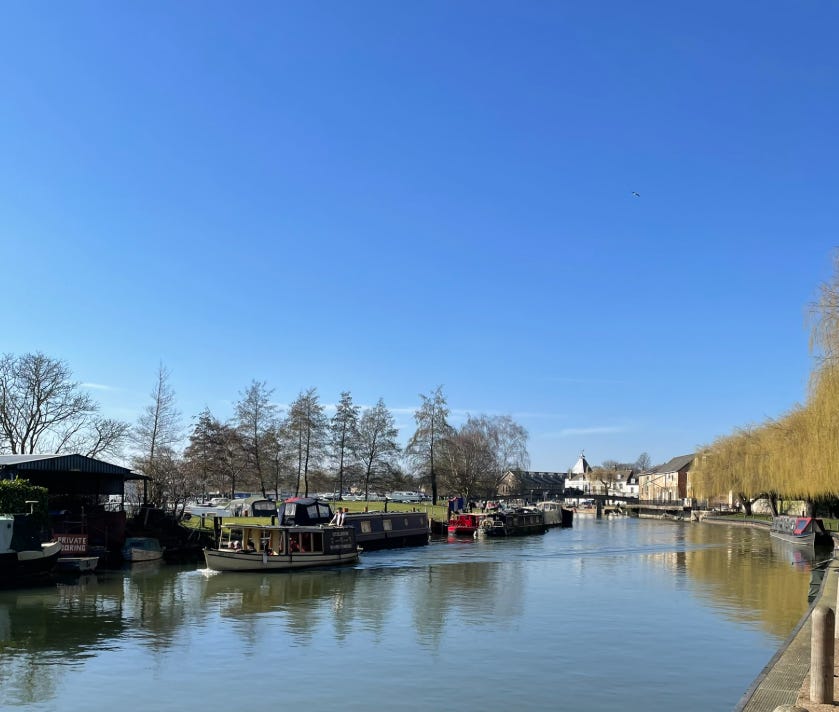
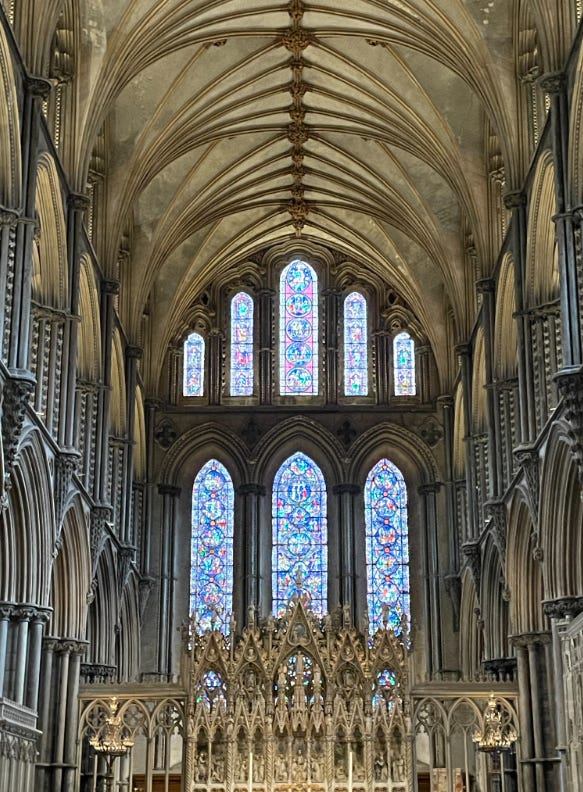
I walk along the river for a bit, then stop for coffee and a scone at Peacock’s Tea Rooms. I browse throught the used books they also sell, but nothing catches my eye. A glimmer of an idea is appearing, so the notebook comes out as I have my elevenses. The next stop’s the market (more used books) and the library (more notes) and then an hour at the cathedral, for the lunchtime recital in the presbytery: a solo baritone, accompanied by piano, singing two sets of verses by Walter de la Mare and Thomas Hardy set to music. The baritone has a beautiful voice, but the music’s not really to my taste. I sit and let it wash over me, looking up at the details of the cathedral — carvings and stained glass — and slowly my mind sorts out the plot problems that were plaguing me.
Lunch, and the book stall again (where I do buy two light reads), then the walk back to the train, and the familiar-by-now journey home. Roe deer in the fields, and distant swans, a swirl of starlings.
Friday March 27/Saturday March 28
Friday was rare wet day, spent in revising An Unwise Prince in the morning, and working on a book I’m editing in the afternoon. The rain stopped overnight. I heard a tawny owl calling some time in the early hours, and woke at dawn to the cooing of wood pigeons.
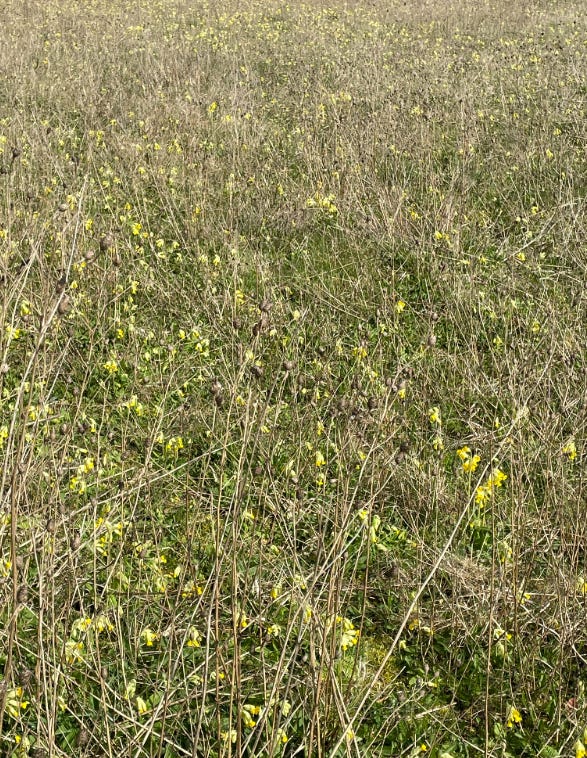
Midmorning, after another couple of hours spent on revisions, we go walking at Courtyard Farm. It’s windy again, so I plot the route to keep us, wherever possible, on the lee side of hedges and woodland belts. More cowslips are flowering in the uncut grass.
In Wharton’s Belt, a strip of woodland planted some time in the second half of the 18th century, a song catches my year. I’ve been hearing robins and blackbirds, chiff chaffs and wrens, but this one is fast and musical: blackcap! The second woodland warbler of the year.
A flock of fieldfare lands in a bare tree; like the redwing earlier in the week, they’re a surprise. I would have expected them to have returned north by now. Hares chase and leap; roe deer and muntjac graze. A buzzard watches for prey from a half-bare tree; a kestrel hovers. The clouds blow past, the sky grey, then blue, then grey again. There are bumble bees on the cowslips, but no butterflies today.