
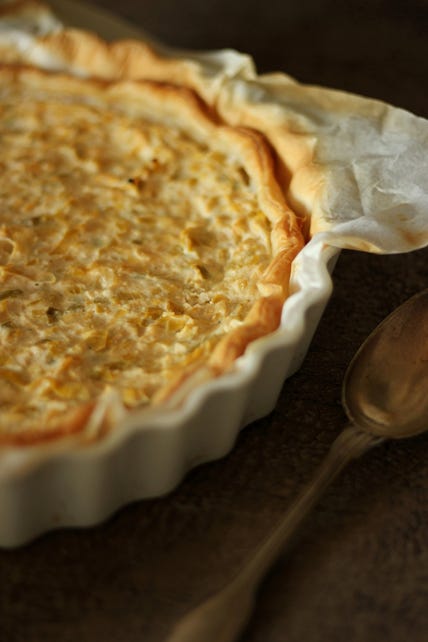
The Onion Tart
"I have brought something for the meal..."

An introduction to my work-in-progress, An Unwise Prince. Set in the same fictional, parallel world as my Empire’s Legacy series, this piece not only introduces some of the characters, but the setting: the world of merchants and trade and politics around a ‘Middle Sea’.
‘Kirthan del Candre de Guerdián en Leste desires an audience.’ Cenric bé Casille read the first line of the note and rolled his eyes. Why were the Lestiani so pompous? A second, more pointed question came to mind: why was Benedit de Guerdián’s older brother asking to see him? Cenric had dealt with Benedit over the importation of spices for more than a decade. For all that time, Kirthan had not stepped foot on Leste, concerning himself with markets in Beria and beyond. Far beyond, if all the stories were true.
Cenric thought about the last letter from Benedit, giving the prices asked this year for olive oil if he bought now; prices half as much again as they had been last year. The increase in the Casillard import tax was not enough to account for it. Had storms or insects ravaged the trees? Benedit had not mentioned either.
I suppose I’d better see his brother. Not here, in the office at Casille’s docks. No member of the de Guerdián family was to be entertained, even for business, in a ledger-lined room at one end of a warehouse. No more than Cenric would expect to be, had he taken ship for Leste and requested the meeting.
Cenric wrote a reply, sealed it, and handed it to the boy waiting, along with a small coin. Then — “Wait,” he said, and scribbled another note. “Deliver the second immediately after the first. Do not dawdle, and there will be another coin from the steward.” The cook would not be pleased to be told, so late in the day, that there would be company for the evening meal.
The boy ran off to earn his coins, and Cenric returned to the account books. After a moment, though, he put his pen down. He should have sent a third note, to the Street of the Healers where his sister had her treatment rooms. Without knowing she should return home early enough to prepare for a guest, Luce was likely to appear halfway through the meal, in her working tunic and leggings. They could even be stained with fluids Cenric didn’t want to think about. Kirthan del Candre de Guerdián en Leste would not be impressed.
Messenger boys were not in short supply. He opened the office door and shouted. Three or four ran towards him, elbowing each other and grabbing at tunics in an effort to be the first to arrive. They lined up outside the door, attempting to look responsible and reliable. Cenric picked the oldest. The Street of the Healers was across the city, a fair distance. He didn’t want the boy stopping to rest halfway there.
The note to his sister written and sent, he finished the accounting. Then he took his cloak from its hook on the wall, shrugged into it, and stepped out into the late afternoon. Gulls screamed, men shouted, rigging jingled. The air smelt of fish and salt, of spices and sweat and the sharp odour from a smashed jug of vinegar, and behind that, the faintly foul smell of the water. In high summer, faintly foul changed to frankly fetid.
But it was still spring, and so the harbour was less noisome. With the sun dropping into the west, Cenric was glad of his cloak. He walked away from the sounds and scents of the docks, leaving the broad paving stones of the warehouse yards for the cobbles of the streets that ran slightly uphill into the heart of Casille. Different sounds and different smells here, some pleasant, some not. At least the wind was blowing southeast, the stench of the tanneries carried out to sea. But the faint odour Cenric caught reminded him of another issue: the first bundles of furs that had arrived from Varsland after the winter harvest had contained almost none of the prized silver squirrel pelts, and those it had were of poor quality. Fewer of the wealthy of Casille would have new trim for their winter cloaks this year, and those that did would pay more for it. His, luckily, did not need renewing.
The bé Casille house stood nearly as high as it was possible to be in Casille, but for the palace of Ésparias’s prince. It was quieter here, and the air fresh. Cenric opened the door, gave his cloak to a servant, and walked through the central room to the kitchens. He stepped into the fragrant space with some trepidation.
“Aldor Cenric.” The cook’s greeting was appropriate. Her tone was not, except that she had been with the bé Casille family for longer than Cenric had been alive, and without her the household would fall into chaos. “A guest, at such short notice, and of such importance?”
“Aldor de Guerdián gave me little warning,” Cenric said, adopting a conciliatory tone. Best to, for while the cook would never serve anything than her best dishes to a guest, she wasn’t beyond pretending they had run out of raisins for his morning porridge. “What delicacies did you order for our meal?” He breathed in, discerning cloves and onion, pepper and ginger. “Lamb?”
“In a wine sauce, with carrots and turnips.” He knew the dish; it was a favourite. “Fish first, and an apple tart after.”
A simple enough meal, but from their cook, it would be worthy of our guest. “You will do me proud,” he told her, before climbing the stairs to his room to bathe and change. Why was he nervous? Benedit had eaten at his table often enough. But he had known Benedit since they were both young, learning their trade. Like Cenric, Benedit had voyaged only between Leste and Ésparias, Linrathe and Varsland. Kirthan, the fabled older brother, had travelled the known world.
A fine wool tunic with silk trim, a ring set with a ruby on his right hand and his best leather house shoes alleviated Cenric’s anxiety a little. In the sitting room, a fire burned on the hearth, and lamps lit the room against the falling dusk. When the steward announced de Guerdián, Cenric turned confidently to greet his guest.
The firelight reflected off the polished wood of the chests and panelling, making the room—and the man who had just entered—glow. Kirthan del Candre de Guerdián en Leste looked as if he were made of autumn oak leaves, shades of gold and brown from the short curls of his hair to the tips of his polished boots. His tunic had insets of bronze silk, the sleeves embroidered with what could only be gold thread. Yet there was something untamed about him, something that the trappings of wealth could not disguise.
Cenric realized he was staring – and that the smile on de Guerdian’s face said he was well aware of his effect. On me, Cenric thought, affronted, a man of mature years and a merchant of standing and not insignificant influence. But, well, de Guerdian was beautiful. And he was holding out a dish, covered in a cloth.
“Thank you for seeing me, Aldor bé Casille. I have brought something for the meal, with your indulgence,” de Guerdián said.
Cenric found his voice. “You are most welcome, Aldor de Guerdián. But—” He tilted his head, to show mild surprise. “Is this a Lestian custom, to bring food to a host’s house? Or perhaps a Berian one you have adopted, as your brother has not followed it in his visits?”
His guest was still holding the dish out. Cenric took it: to do otherwise would be impolite. Should he remove the cloth?
“Not a custom of either Leste or Beria,” de Guerdián said, his amusement evident. “I have brought a tart so that you can taste the quality of the safran I have come to offer you, how it retains and deepens its flavour after cooking. What better way to convince you it is worth its price, Aldor bé Casille?”
“Safran?” Only the very wealthiest could afford safran, the golden threads harvested from an autumn-flowering bulb in countries beyond the eastern end of the Nivéan Sea. It took, he had been told, hundreds of thousands of flowers to produce even a small amount of the dried spice. “Aldor, I am afraid—”
“That I have been misled as to your ability to invest in such an expensive trade?” That grin again, and a long-fingered hand run through already tousled curls. “Will you hear me out, bé Casille? And should we sit?”
“Of course,” Cenric said hastily. He had forgotten his manners. What would de Guerdian think of him? “Wine?”
“Certainly. My brother has praised your cellar.”
Cenric poured two glasses. De Guerdián held his out, letting the firelight shine through it. “Fine glass.” He sipped. “And the wine does it justice. Now, Cenric—I may call you that?”
“Please.” You may call me anything you like, he thought, watching a finger caress the bowl of the wine glass.
“I have spent much time in Beria, as you will know. A farm in which I have an interest has recently begun to grow safran, in certain fields where the soil and rainfall and temperatures are to its liking. The harvest is still small. But large enough this year, I believe, to be significant.”
What he was saying penetrated. “You are growing safran in Beria?” How had he obtained the bulbs? They were more precious than rubies, kept guarded by men with knives and no compunctions about using them – or so it was said, around the merchants’ tables.
“I am.” De Guerdián grinned. “And I am offering you the first harvest, and an opportunity to invest in its production. But shall we taste that tart, before you decide?”
“Why me?” There were other merchants, some with greater networks.
“My brother,” his guest answered, “thought we would find certain commonalities. I believe he was right.”
Cenric had no chance to frame an answer: the steward knocked and entered. “A message, Aldor. From your sister. She has been called to attend a patient, and sends her apologies.”
“Thank you.” Cenric didn’t think he minded. “Will you bring us two plates, and forks, and a knife, please?”
He would only be gone a minute. Cenric watched the man sitting across from him. He sat perfectly still, legs crossed at the ankle, but for one finger moving on his wine glass. Neither of them spoke. The fire crackled.
“Is there something you would like me to serve?” the steward asked, returning. Cenric shook his head. The steward retreated.
“Shall I?” De Guerdián rose, fluidly, going to the chest the tart sat. He lifted the cloth. The scent of onion and—yes, safran—rose. The pastry was fluted and perfectly browned; the surface of the custard nearly as golden as his skin. He pushed his sleeves back before he made a cut. Cenric’s throat tightened. There would be a bracelet—in gold, of course—on the left arm. Surely de Guerdián was married – in Beria, years ago? But the fine bones of his wrists were unadorned.
“Your cook,” Cenric said, through a mouth suddenly dry, “has baked a fine tart.”
De Guerdián finished cutting the slice, lifting it carefully onto the plate. “Not my cook. I baked this.”
“You?” This elegant, feral man?
Cenric watched him cut a small piece and spear it with the fork. “I must know how the spices I offer behave in various dishes,” de Guerdian said, cupping a hand below the fragment of tart, careful of the carpet. “How the tastes change with cooking, or when mixed with other ingredients. I can watch a cook carefully, or I can do it myself. I prefer”— he moved to crouch beside Cenric, extending the fork to his lips—“not to watch.”
Cenric took the morsel onto his tongue, tasting the onion first. Then the earthy, sweet flavour of safran, like a rich honey, took his attention. He closed his eyes to better concentrate on the flavour, letting the custard dissolve. A finger touched his mouth, brushing away crumbs of pastry.
Cenric swallowed, parted his lips almost involuntarily. “Kirthan,” he whispered.
“Kirt,” the man before him said. “Kirthan was my father.”
His lips tasted like wine; like the scents of ripe fruit carried on the wild winds of autumn. A long kiss, before he drew back. “So,” Kirthan del Candre de Guerdián en Leste – Kirt – said, one hand on Cenric’s knee. “Are you interested in a partnership?”