

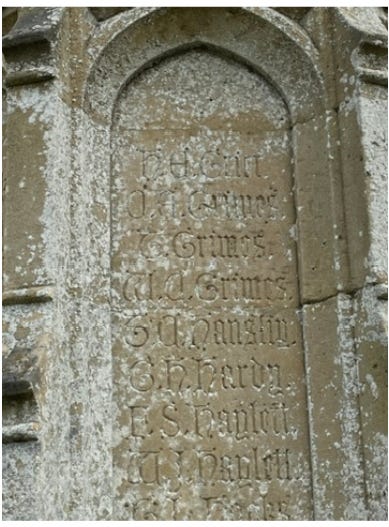
This not terribly wonderful photograph is of the war memorial to the Sandringham Company, the military company of about 100 men (and boys) raised entirely on the private royal estate of Sandringham in Norfolk. From an estate of perhaps 25 or 30 square miles, led by the land agent Frank Beck and as part of the larger 5th Norfolk, they landed at Sulva Bay as part of the Gallipoli campaign.
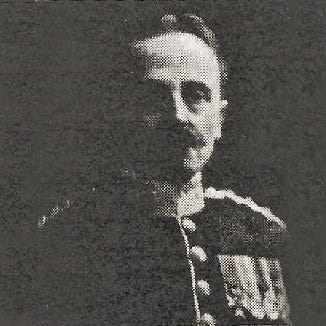
They all died. Details of the ill-fated attack can be found here. There are, if I counted correctly, 77 names on the memorial that stands outside the gates to Sandringham village and church, including Frank Beck and his two nephews. And including three whose last name was Grimes.
They’d almost certainly been my grandmother’s cousins. Her grandmother — my great-great grandmother, Catherine Grimes — was born in West Newton, one of the villages on the estate, and in rural Norfolk in the late 19th/early 20th centuries it’s a pretty good guess that they would have been related. I don’t know if these men were brothers, or cousins, or like Frank Beck and his two nephews, they spanned a generation. What I do know is they didn’t come home.
All these young men, so much of the labour force of the estate and the life of the villages — the impact must have been devastating. But we know that, from many books and plays, documentaries and historically-based films. I’m not dismissing it, or minimizing it, but it’s not all I’m thinking about. What I am wondering is why my grandmother never spoke of it.
She grew up less than a mile from Sandringham, where her father was ‘tapissier’: the man in charge of the furnishings of the house. A cabinet maker by trade, he’d come to Sandringham from London to work on the interior, and was asked to stay. He was a senior servant; he — and his sons and daughters — knew Frank Beck. Because my grandparents lived with us in the first decade of my life, I grew up hearing her stories of life lived at the estate. I knew Frank Beck’s name before I went to school, probably. But she never mentioned how he — or the putative Grimes cousins — died.
I can come up with several reasons for this. One is that she was married and living in Bedfordshire during the first World War, and so didn’t absorb the full impact of these deaths. But that doesn’t fly for me: she never lost her connection to her family (indeed, she moved back home, two small children in tow, between 1923 and 1930, to care for her father after her mother died) or the estate, her brothers and one sister’s husband remaining in royal employment. The second is that she simply didn’t talk about the war and its cost — I don’t remember it ever coming up, not in the stories she told me or the adult conversations I eavesdropped on. But perhaps there was a third reason too: her youngest brother, had he remained on the estate, would have almost certainly been part of this regiment. Like his father, he was a cabinet-maker, and when war broke out he was working at Buckingham Palace, not Sandringham. He served three years in the trenches of France and survived. Did his sister, my grandmother, feel a mix of relief and guilt that he’d moved to London?
I’ll never know, of course, but of such things stories, of the sort historically-inspired novelists like me write, are born. Will I use this? Probably, in a roundabout way, in the current novel. It won’t be recognizable, but I’ll know.
(It’s not the only story my grandmother never told, and perhaps I’ll write about another one day.)
Find my books at: https://scarletferret.com/authors/marian-l-thorpe
I only know of my family members who fought in WW1 and survived, but from a bit of family research I can see that there were various siblings/cousins of that generation that I know nothing about. Did some die? Perhaps. Walter Benjamin in ‘the storyteller’ speaks of a generation grown silent, unable to translate the experience of the trenches, the trauma of mass slaughter, or mechanised war, into meaningful stories. But I guess family history is also largely an oral history and there is so much that isn’t fully passed on from one generation to the next.
Fascinating. It's strange to me, the kind of stories that either never get shared or have to be unearthed elsewhere.