
This Writer's Diary: 10 Weeks
Week 4

This post is too long for some email services, so please open in your browser.
Sunday March 1
To the north of the river Nar, and south of the village of Middleton, lies an area of active and past quarrying, for carrstone and sand. Older pits are now lakes, mostly managed by various fishing groups. But the birds don’t know that, and so this is also place with both good walking and good birding.
The Nar Valley Way parallels the river, occasionally switching sides. We used to walk further, turning south at the bridge at Pentney Abbey and making a long loop through poplar plantation and carrot fields, past the motte-and-bailey castle remains at Wormegay, and across a dyke back to the river. But the footpath along the dyke is unmanaged, the walking rough and difficult now, and my bad hip doesn’t like it. So now we do a shorter route, 8.5 k rather than nearly 14, circling north through the West Bilney woods and past Pentney Abbey Farm to reach the river again.
There are always siskin here, foraging in the alders that line the banks of the lakes, and sometimes redpoll. This year only the siskin are here, but in numbers, their high-pitched calls giving them away. Tufted duck and coot are the predominant birds on the lakes, but there are also great crested grebe and mute swans, Canada geese and wigeon. Three cormorants share an island with a grey heron.
At a feeder on the approach to West Bilney woods we stop to watch goldfinch and chaffinch, blue and great and coal tits, and one robin taking adavantage of the food. A bit futher along a dog barks and barks at us, chained outside a doghouse at the edge of a property littered with farm machinery and old vehicles. Poor thing.
There’s a heavy cone crop in the tall pines of West Bilney woods, and so I’m not entirely surprised when, a bit later, back on the Nar Valley Way, Brian calls: ‘Crossbill!’ A male, perched high on a decidious tree. When it flies, it’s joined by a female, dull yellow to the male’s orange.
We’ve watched river improvements here over the last decade, the channelled Nar flowing fast between its artifical banks. Bundles of willow were staked to the riverbank in places; now almost all of those areas are stands of reeds, slwoing the flow and providing both bank stability and habitat. The reed buntings approve. I look, in vain as always, for water vole.
Monday March 2
A leisurely day for me, after the longer walk yesterday. I take the bus to the nearby village of Castle Rising. The 12th century castle’s closed today, but it’s not why I’m here. I want to look at the church, intrigued by the description on Simon Knott’s Norfolk Churches site: ‘the space you step into feels much smaller than it looks from the outside’. Reverse TARDIS architecture.
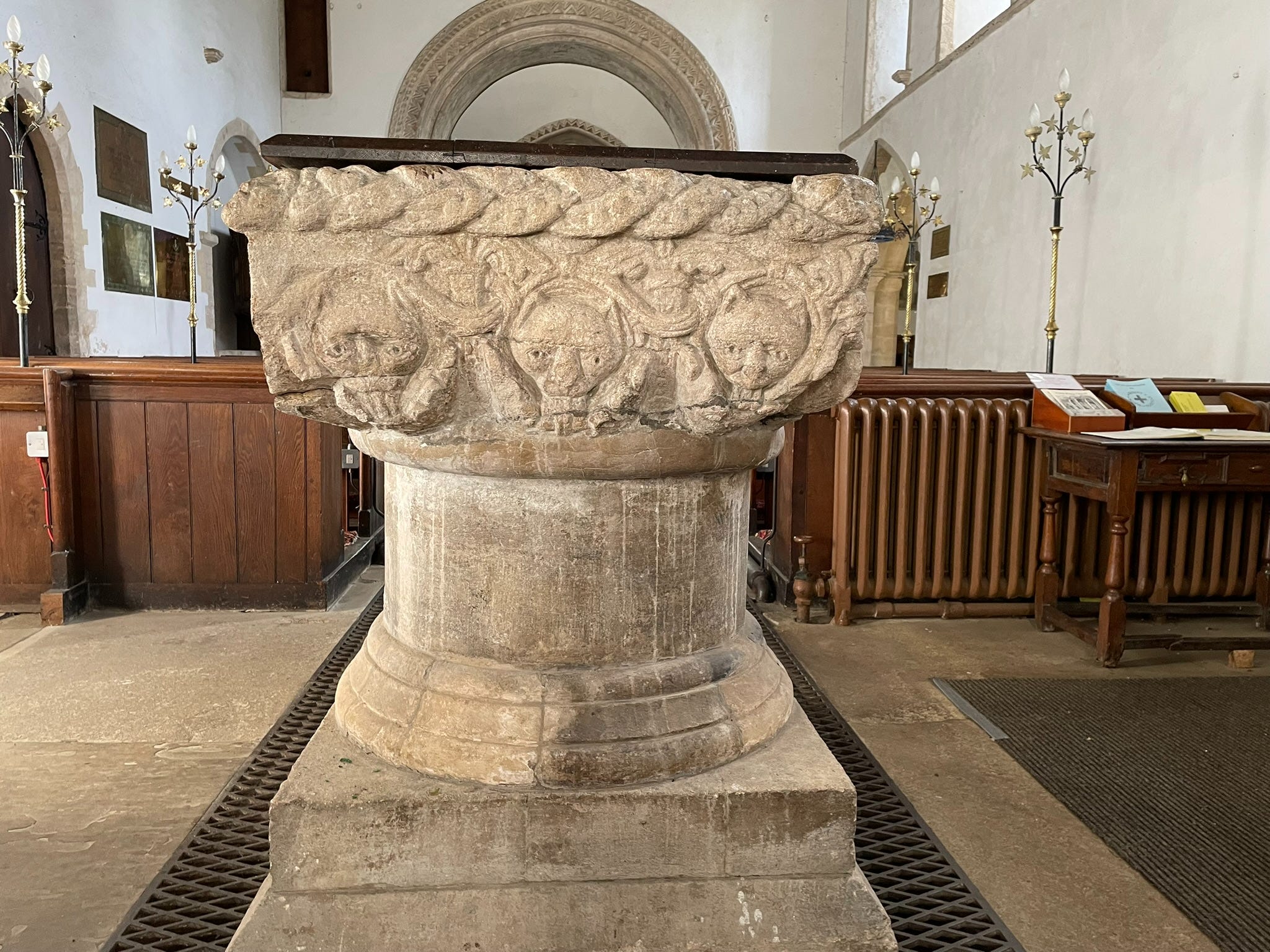
And he is (of course) right: it does seem smaller. The 12th century baptismal font, moved from the old chapel at the castle, dominates the entrance area. Three cat heads adorn it, presumably, the church history leaflet tells me, because the chapel at the castle was dedicated to St. Felix, the founder of Christianity in this part of Norfolk, and the heads are a play in stone for felis, the Latin for cat. I wonder, actually, if they are supposed to be beavers. (If you don’t know the relationship between St. Felix and beavers, see below.)1
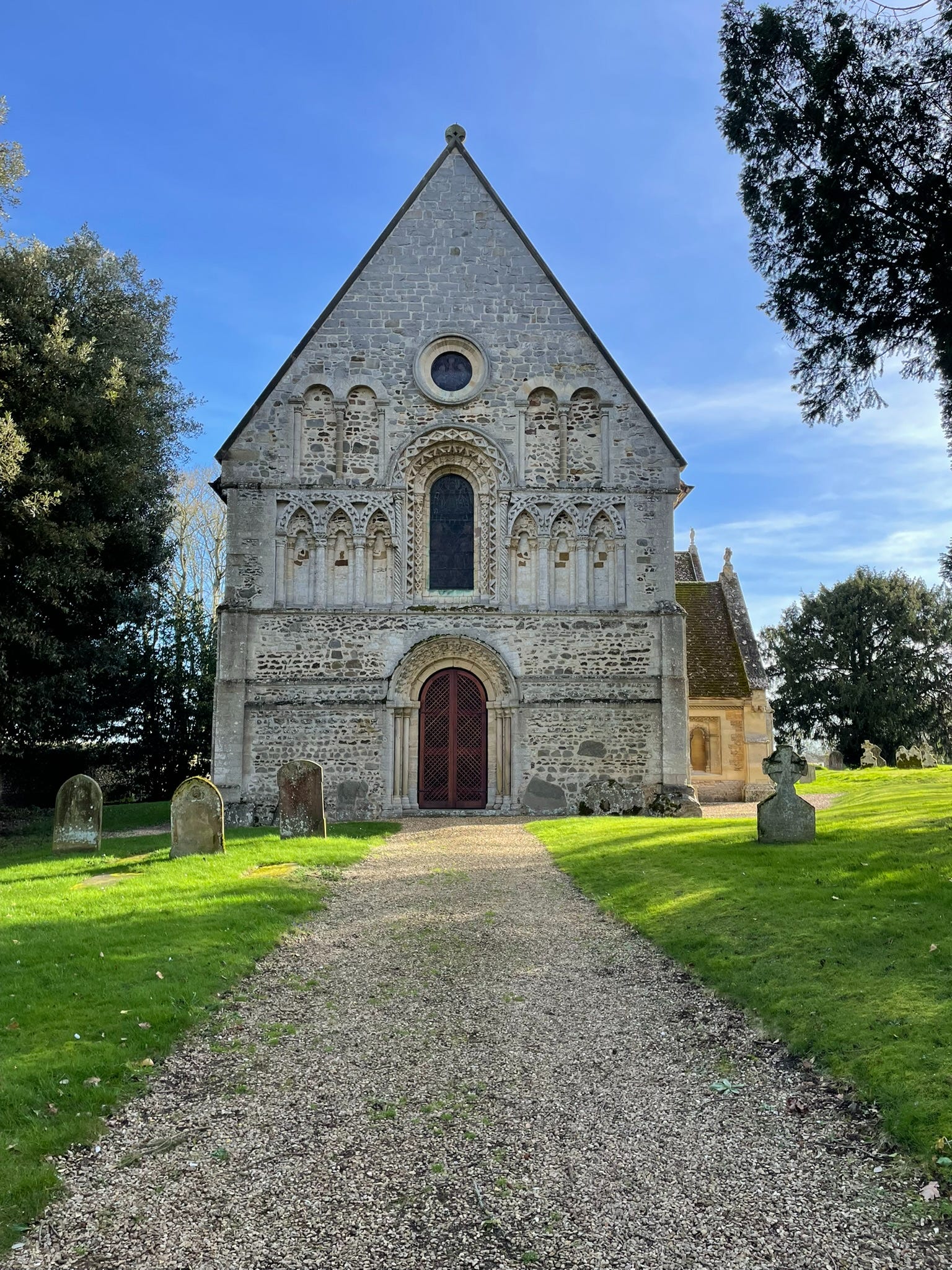
The west front of the church is a marvellous piece of Norman architecture. William d'Albini the younger, 1st Earl of Arundel, who built both castle and church, was out to impress.
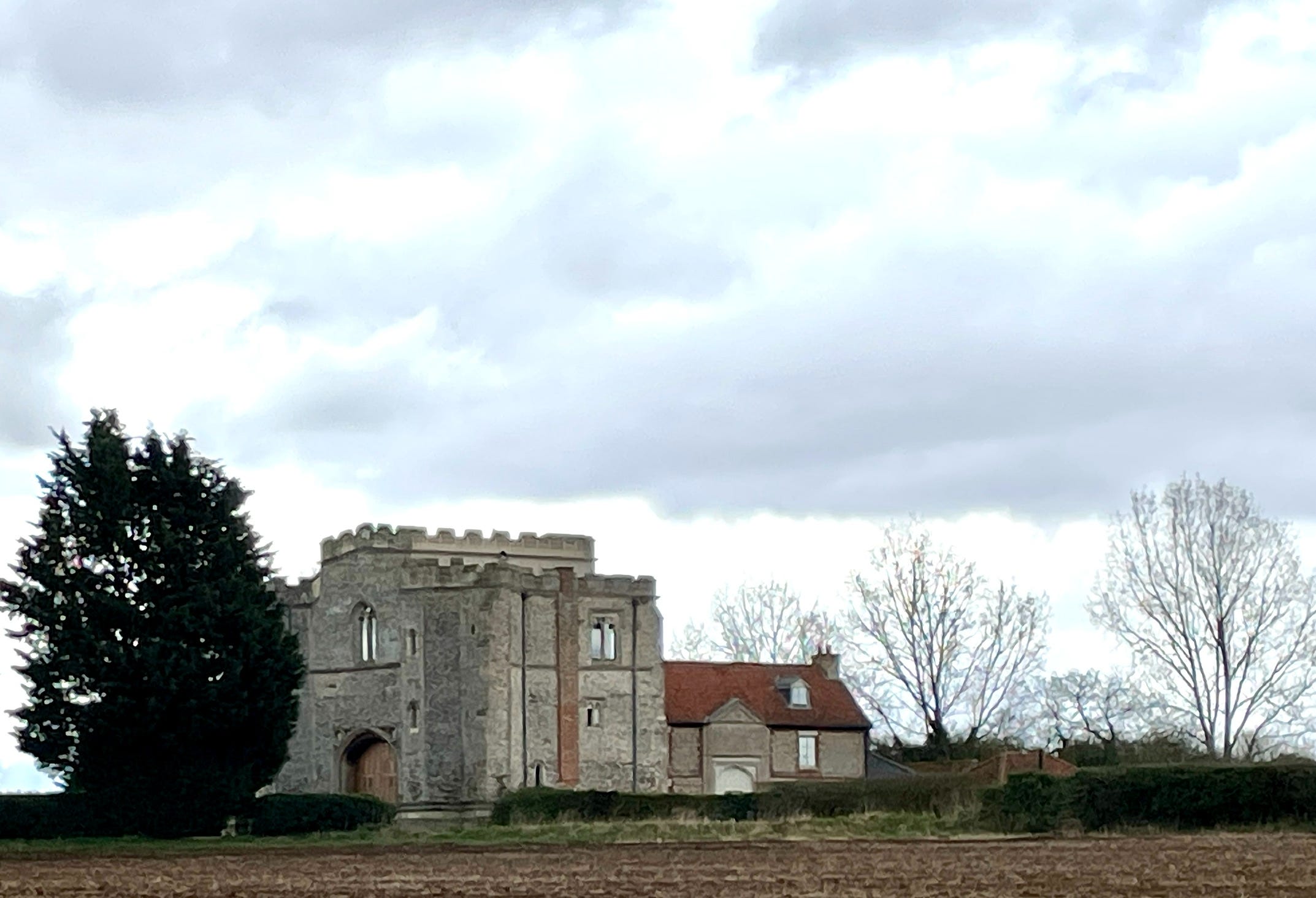
I spend a couple of hours wandering around the village. To the north, just visible across the fields, is a ruined 14th century church dedicated to St. Felix. Jackdaws play around its crumbling tower; sheep graze in the fields below.
Deciding I need a little more exercise, I take the bus back as far as Sandringham, and, after lunch there, walk back across the common to our cottage. In the birches that dominate the common, there are the usual tits, but from high among the branches siskins trill.
Home again, I make the last changes to the ‘Courage’ story for the anthology, and send it off to the editor, to await her comments.
Tuesday March 3
For just over 100 years, a railway ran from King’s Lynn to Hunstanton. My father used to take the train to and from Lynn to go to King Edward VII Grammar School, but its chief purpose was to bring holiday-makers (and the royal family) from London to west and north Norfolk. The line closed in 1969; the tracks were torn up, and the bed became an unofficial footpath between Dersingham and Snettisham. Disputes followed; in the end, the people won this one, and the footpath is now official.
Today’s walk is along this footpath, into Snettisham, and from there into the high West Norfolk sandstone knoll that is Ken Hill. (Interestingly, on old maps, this is Caen Hill, the same spelling at Caen in France, the source of much of the limestone used to build 11th and 12th century high-status buildings in England.) This is also the general area where the Snettisham Hoards were found in field below the hill, and on the hill itself are (apparently) the remains of Snettisham Lodge Hill tower, probably a medieval warrener’s lodge from the 15th/16th century, or possibly a watch tower.
The footpath was clearly a road of some sort once, wide, banked, and lined with tall beech trees. A great spotted woodpecker drums somewhere in the trees. Jays call. We turn west, onto a field track and out to the marshes. A pair of muntjac chase in what I assume is a mating ritual.
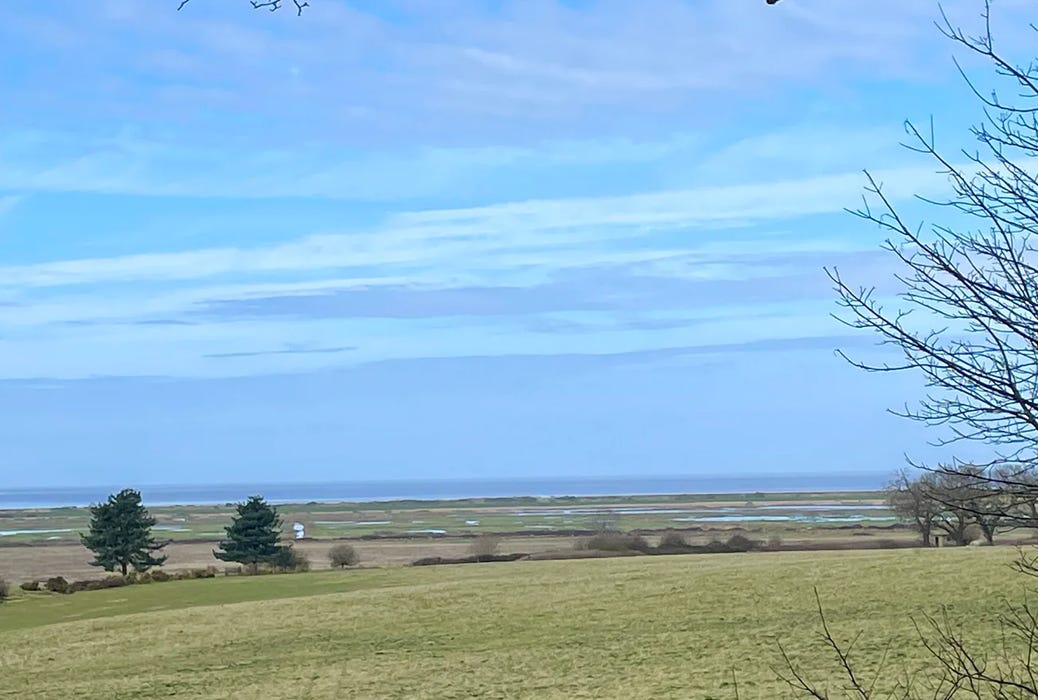
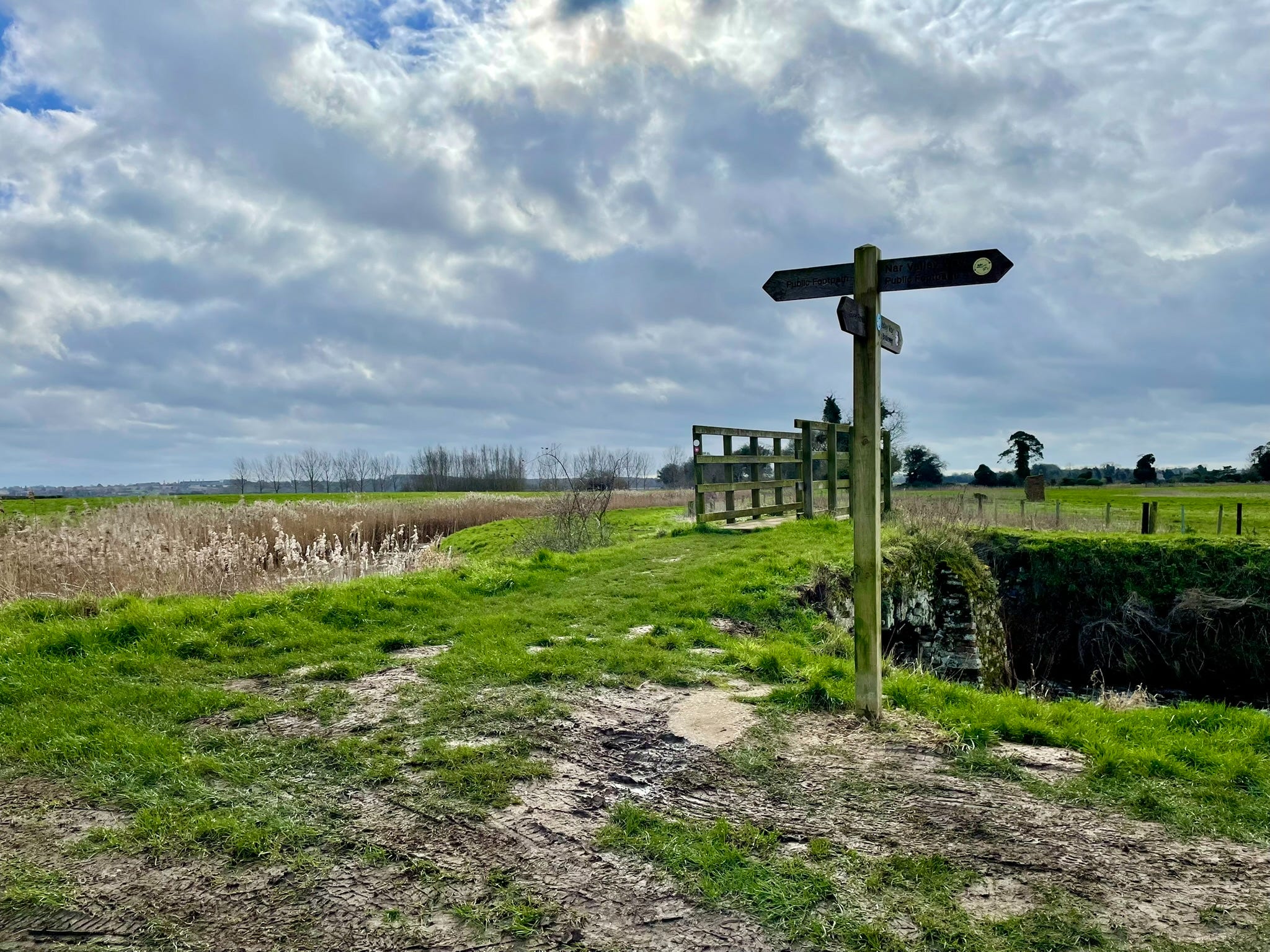
Geese, greylag and Canadas. Mallards and shelduck and teal. A grey heron, motionless at the edge of reeds. The track becomes path, muddy underfoot, and then squashy, water and grass intermixed, until it finally becomes a series of yellow marker posts fully surrounded by water. It is passable in the summer, or so the signs claim. Places like this, at the intersection of land and water, paths negotiating or disappearing in that intermediate realm, occur in my dreams fairly often, and there’s a sense of that dreamworld when I stand at the last bit of semi-solid ground, looking onward.
Later I meet with my writing group via Zoom, to listen to a wide range of writing and participate in some good discussion. What does, exactly, separate genre fiction from literary? How closely should a genre writer stick to the expectations of that genre? And when does a poem meet the criteria for ‘cowboy poetry’?
Wednesday March 4
This is turning into the most glorious week. With errands to run in Lynn, we decide to go back to Roydon Common, the closest place to the town for a long, empty-of-people walk. “Empty” is not what you’d think from the small parking lot, which is nearly full at 9:15 in the morning, but those cars belong primarily to dog walkers, who mostly keep to a grassy section of the common. When we go through the kissing gate into the heathland, we leave people and dogs behind.
Roydon is reliable for woodlark, but even though it’s 15C and sunny, it’s still a bit early. No woodlark, but more stonechat than I think I’ve ever seen in one place before. On a sandy track, a hare lollops towards me, apparently oblivious to my presence. I don’t remember seeing hares here before, but there’s a second one, too.
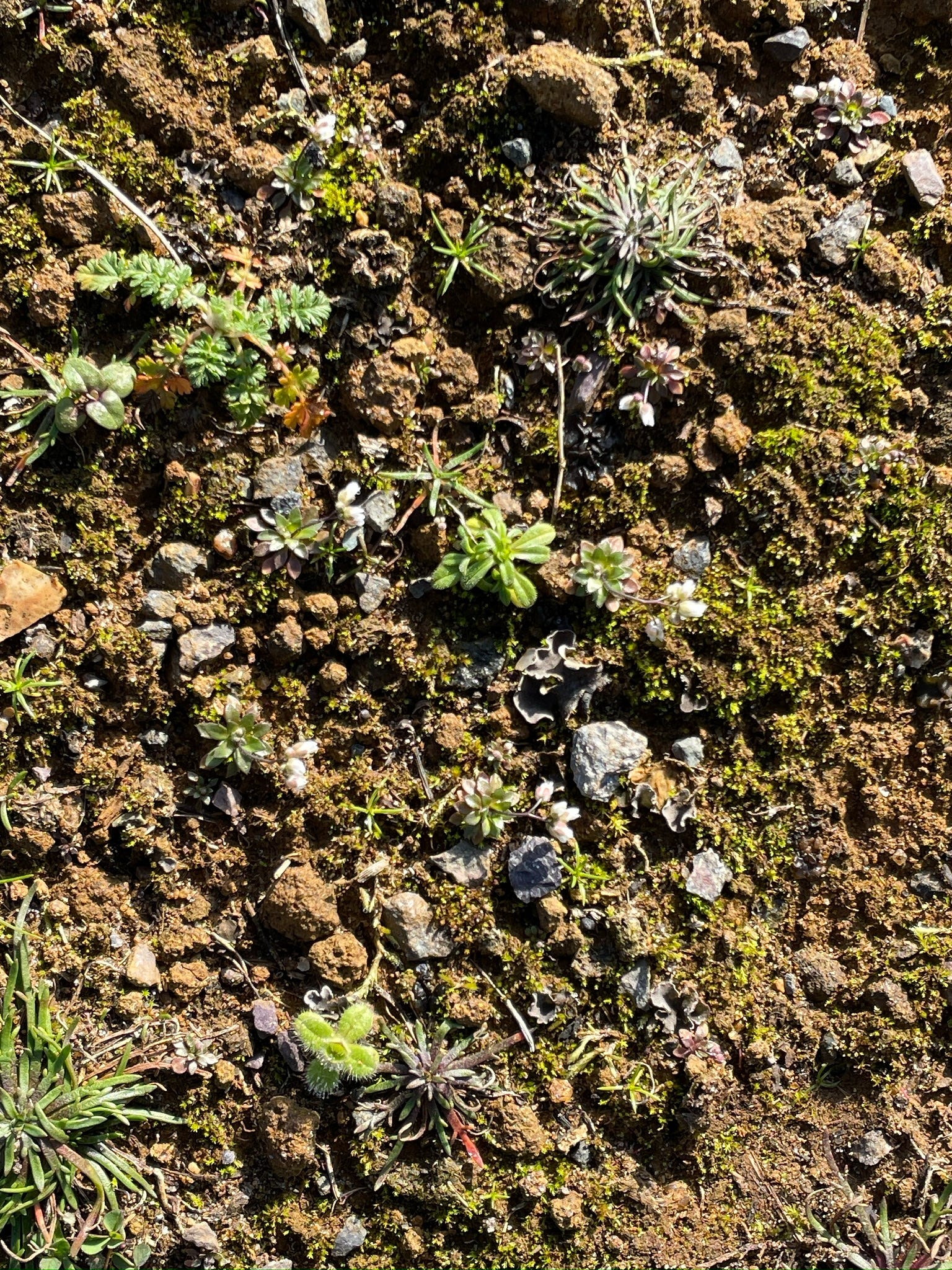
I stop to adjust a shoe. Below my feet is a world in miniature, tiny flowers, mosses, tiny plants.
Perched in a clump of heather, a wren gives itself a good scratch, ignoring me watching it. The red kite in a tree a bit further along the track, having a snack of something small, does not appreciate being observed, and flies off, with whatever prey it had still clutched in its claws.
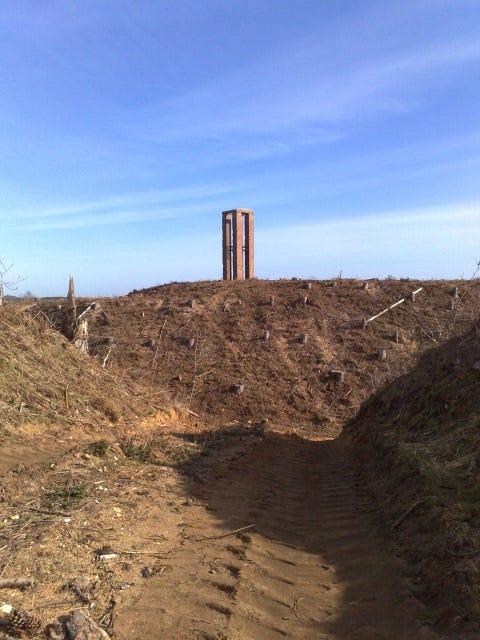
During World War II, Roydon Common was a gunnery range. Two towers, used to monitor the fall of shells, still stand, one on the Norfolk Wildlife Trust land, one on private land nearby. The photo below, from 2009, shows not only the tower, but the rehabilitation work transforming the area from plantation back to heathland.
Back at the grassy field, most of the dog walkers are gone. The sky is full of lark song. I sit to listen to them for a while, then cross the road to a hedge of blackthorn, hoping for a butterfly or two. I’m rewarded by a peacock butterfly, the first of the year.
Thursday March 5
The bedroom window is open, and in the night I hear a tawny owl. As dawn lightens the sky a song thrush begins its bubbly, varied song. I listen, content to stay snuggled under the duvet for a while longer, enjoying the concert.
A moorhen is frequenting the garden, or more precisely the gravel of the drive. I don’t know what it’s finding when it pecks at the ground, but it keeps coming back. The blackthorn in the garden is in flower, and the wood pigeons are feeding on the buds — are they knocking down bits the moorhen likes?
Thursday is my day for Ely. I’m not much in the mood for working; I do a bit of editing before I leave to catch the bus to the train station, and I take my laptop. But it’s too nice a day, and I’m temporarily tired of words. And it is so absolutely lovely when I get there, I decide to have brunch on an outdoor patio overlooking the river — it’s warm enough for that — watching the swans and mallards. Then I wander up to the town centre, do some shopping, write a few notes on edits to An Unwise Prince, before it’s time for the lunchtime concert at the cathedral.
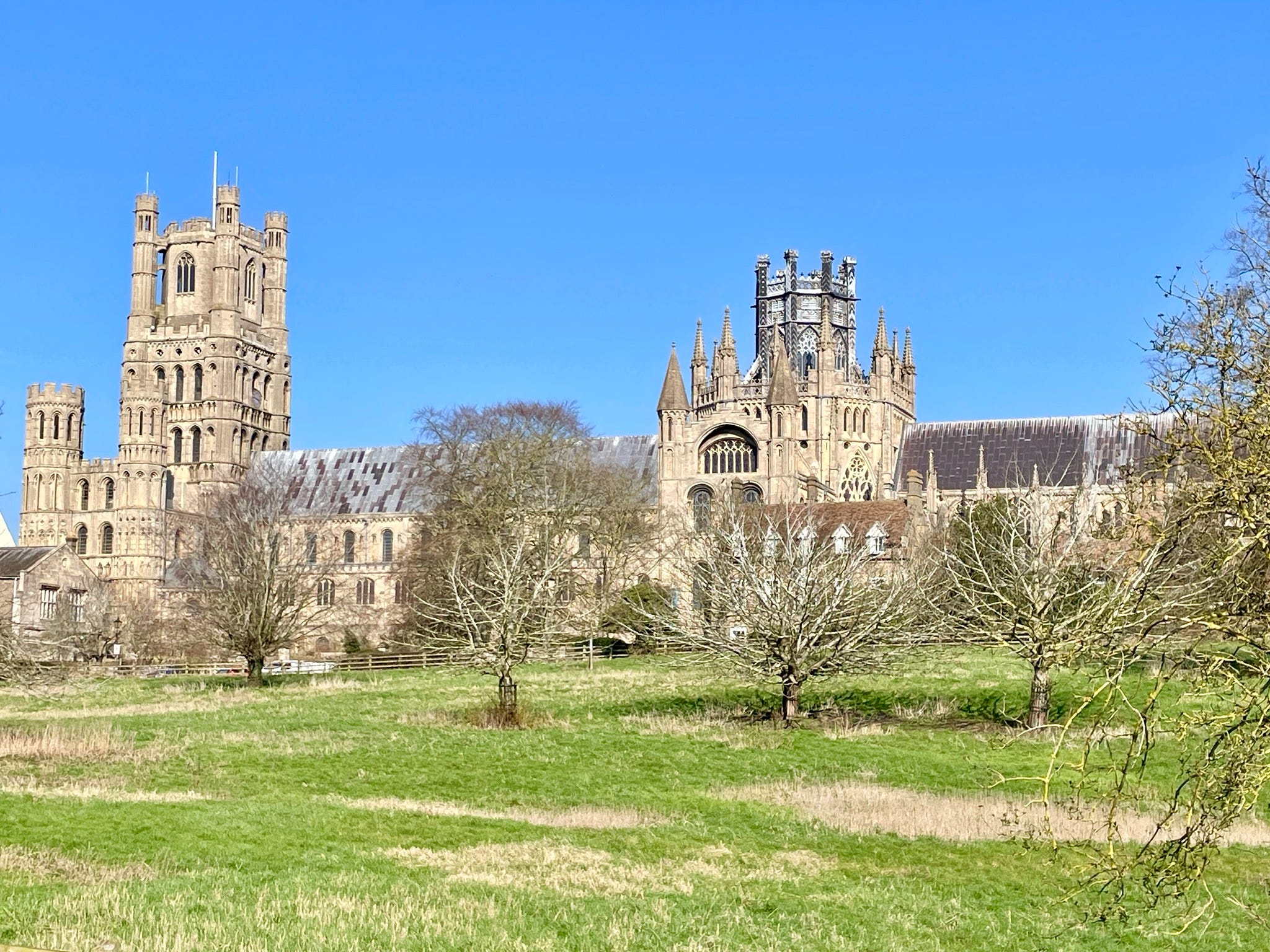
The light today is so clear the cathedral seems to glow. My iphone camera can’t do it justice.
Friday March 7
Today begins the slow, chapter by chapter analysis of draft 1 of An Unwise Prince. I’m looking at several things, but primarily this: does each scene/chapter advance the plot, build character, or build the world? — and preferably at least two of the three. Is character behaviour and plot consistent with the theme of the book? — duty vs. individual autonomy in a world grappling with danger. (Yes, for those of you who’ve read my books, this is always my theme. Maybe someday I’ll suprise you with something else.)
We have plans to meet friends for a birding walk and lunch today. After the glorious week it’s colder again, and the day starts foggy. On the way to our rendezvous at Courtyard Farm, Brian and I stop at Hunstanton to look for fulmar. They nest on the cliffs here, and after a chilly walk down to the beach, we find them, some gliding over the water, some on the nest sites on the striped cliffs. At the tideline, ethereal through the fog, oystercatchers and redshank and sanderlings feed.
The fog does lift, and our walk with friends around Courtyard Farm is suprisingly birdy, including, for me, the first chiff-chaff of the year. ‘Chiff-chaff, chiff-chaff’ it sings, the definitive sign of spring. Both primroses and cowslips are flowering. We talk about the decline in house sparrows; the damage done to habitat by the explosion in the muntjak population; the changing face of Norfolk agriculture. A small flock of fieldfare, with one redwing, poses nicely in the trees.
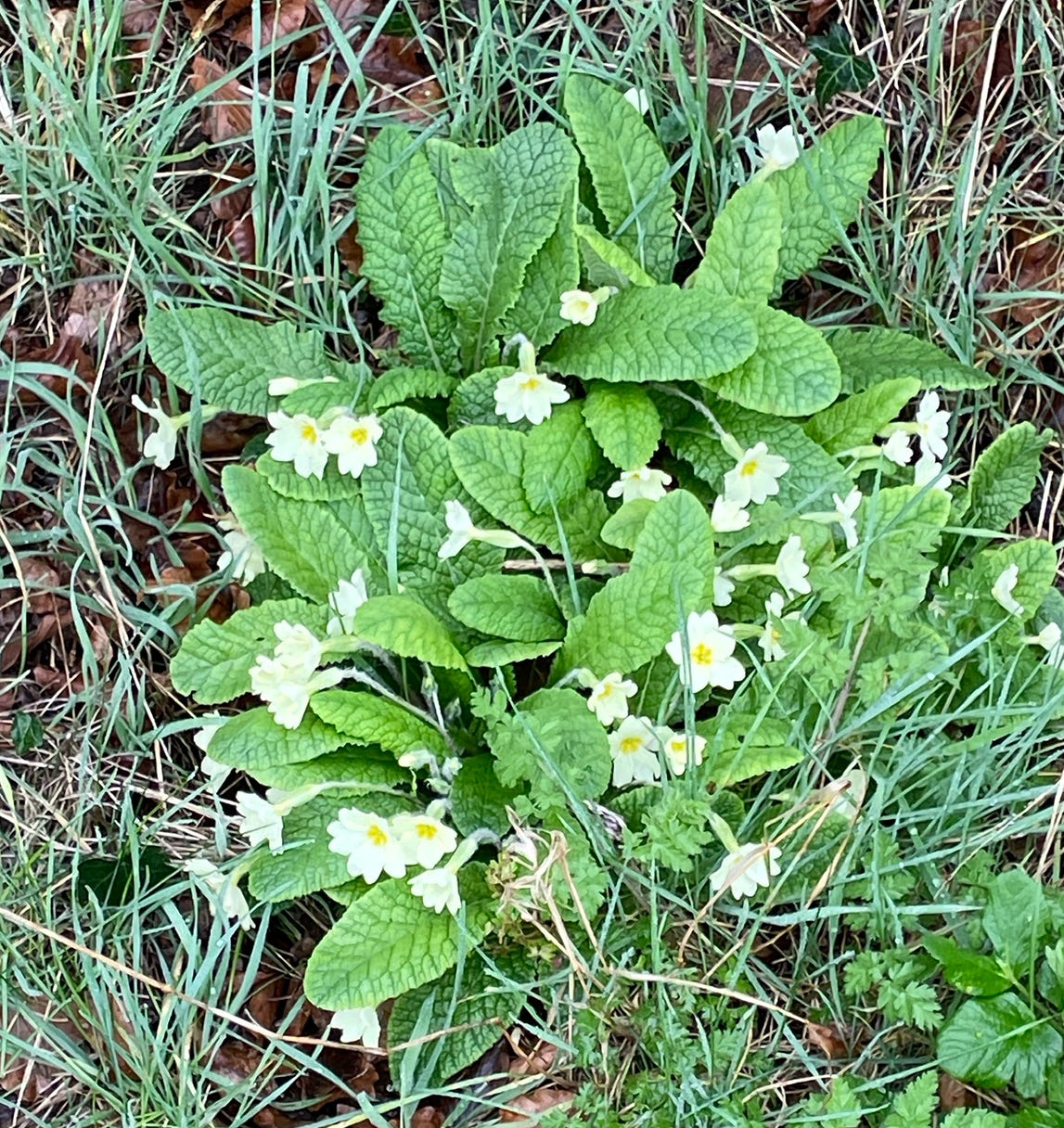
Lunch at Eric’s Fish and Chips warms us up. A bit of shopping at Drove Orchard’s farm and fish shops, and back home to continue with An Unwise Prince.
Saturday March 7
Water rails are supposed to be shy birds, but no one has told the resident water rail (s) at Titchwell. The west ditch near the visitor’s centre is a fairly reliable place to see one, and today’s no exception. I’m draggy today, lacking in energy, so after a stroll around the woodland paths and boardwalks, with a look at the roosting tawny owl, I return to the visitor’s centre and cafe to wait for Brian. Tea and toasted tea cake are in order.
Most of the rest of the day is spent on the analysis of An Unwise Prince. I’m identifying some plot holes and weaknesses, and making note of subplots that may need removing — or may be resurrected in the second book of the duology. Much to think about.
Such a rich composite of history, architecture, and nature with your fascinating writing process nestled in between.