
This Writer's Diary
January 24, 2026

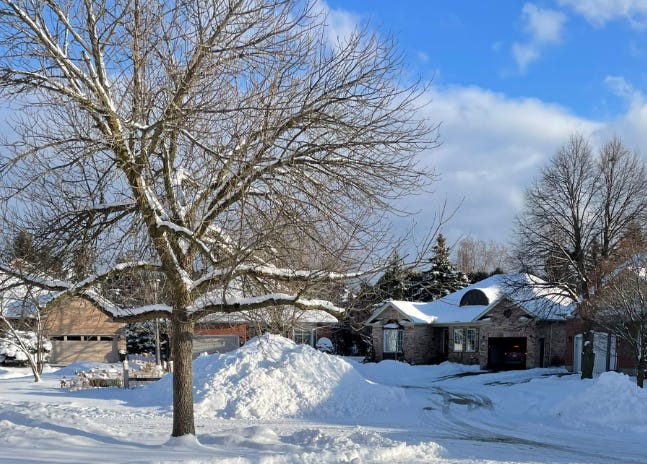
I am not going to bore you with the weather. Suffice it to say we have a snow mountain outside my front window, a smaller one on the deck from shovelling a way out to the bird feeders and heated water dish, and a day when it’s -5C feels balmy. Almost all the birds have found other feeders with better shelter nearby, except for our flock of goldfinches, which are eating their way through expensive bags of chipped sunflower seeds at an alarming rate. A flock of starlings comes through occasionally, but they can’t get enough food from the weighted squirrel-proof feeder, and they can’t get into the caged ones.
All my walking is done at the local shopping mall before the stores open. 4 circuits = 5 km. Exceptionally boring, but no slip-sliding to aggravate my bad hip, or frigid air to make me cough. No birds, either, except for the red-tail seen perched on a building on the way there and the occasional flock of feral pigeons.

I’ve just started an edit of a long fantasy novel, and I have a ‘fictionalized memoir’ lined up after that. And a commissioned short story to write for an anthology, as well as the usual flash-fiction-length stories for my writing group, although last week I cheated and used an excerpt from one of the novels instead. There isn’t always time to write something new. Not of any quality, at least!
An Unwise Prince is nearly done, in its first iteration. The last scenes are written, the turning point of this half(?) of the story complete. Two chapters to insert, from the points-of-view of Audun and Rothgar, separate in geography from Kirt, Cenric and Luce, who are together in these last chapters.
But a lot of editing and revision to do, of course. That’s my task for February through April (or however long it takes.) The big revisions: checking pacing, eliminating subplots that aren’t necessary, strengthening the main plot, correcting inconsistencies, adding foreshadowing for plot points I hadn’t preplanned. The smaller ones: adding action and sensory detail to several chapters that are, right now, almost entirely dialogue; tightening the writing, looking at word choice and sentence structure. Unlike some writers, I really like this stage.
Here’s an unedited scene from around the middle of the book, when those of royal blood, the cyn Rihtera of Ésparias, are gathered for a funeral.
Luce had asked their cousins, specifying only the oath-bound adults, to meet in the library. Calmly, but with a tightness to her voice, she had informed the gathered cyn Rihtera of her deception, the truth held back until they were all present. Varril, their prince, was not absent due to illness. Concisely, and without naming Cenric, a small concession he hadn’t expected, she’d explained the series of events that had sent the Prince north.
“Sitryg agreed?” someone asked.
“How could he defy the Prince?”
“He could not. We of the army have sworn a second oath of loyalty and obedience.” The answer came from Tedha en Whitstanburgh. A rumble of voices followed it, quickly silenced when Luce raised a hand.
“Who warned the Casillard?” Mateu bé Bereham.
Cenric felt Luce’s eyes on him. He stood. “The palace chamberlain, under instruction from Sitryg. I was there when he gave the news to the Forsittë.”
“A good decision. The Casillard needed to know.” Cenric did his best to hide his surprise. The defence had come from Fryth bé Whitstanburgh, Tedha’s daughter. She spoke confidently, as if there could be no argument against her position. “Torben’s disagreement with the northern Casillard cities could well lead to a blockade of trade through the canal, trade that provides much of Ésparias’s wealth. Mateu, much of your grain is shipped north, is it not?”
“It is.”
“For that alone the Casillard should know, so they can find new markets, adjust trading patterns. But a study of past wars” – she smiled – “and yes, there have been wars, although not on Ésparian soil, tells us that the Casillard also funds troops, whether to complement our army or in the cities under attack. Again, forewarning of that possible need allows them to plan, not react.”
Heads nodded. Most of the cyn Rihtera were landowners, producing grain and wool, mining metals or quarrying stone for building. The one coastal holding also dealt in fish and salt. A wave of gratitude swept through Cenric. Fryth had succinctly summarized the reasons, far better than he would have.
“Is that the most important question here?” Another woman’s voice, young, bordering on strident. She stood, slight but muscled, pale hair tied back. Cenric searched for a name. Mirèla bé Scapham. Newly head of her estate, after her mother’s death last year. “Shouldn’t we be considering the Prince’s actions? How can threatening Torben of Varsland, whose issues, the Magister Luce tells us, are with two foreign cities and the Casillard, be in any way for the greater good of Ésparias? Hasn’t the Prince violated the oath he swore – we all swore – at eighteen, and again on his election?”
It was said. Not subtly, not hinted at, but said, plainly and directly, by the youngest of them. Mirèla, Cenric realized, was only a handful of years older than Audun.
Tedha’s shoulders had gone back, her upright stature now rigid – with shock? Anger? Varril’s father, Cenric remembered, had been Tedha’s much older half-brother. Hurriedly, Cenric stepped forward, a hand raised for quiet. “I believe that was a question of clarification, not an accusation. Was it not, Aldorin bé Scapham? You are asking for your elders’ instruction on this, to further your understanding?” Cenric regarded her, his features, he hoped, benign, non-judgemental. He waited for her to accept the interpretation, to withdraw the dangerous words. He widened his eyes, inviting a response.
Mirèla’s gaze dropped. “You are correct, Aldor bé Casille. In my haste to ask advice, I did not think out what to say. How to say it, that is.”
The relief in the room was almost palpable. Mirèla sat again; so did Cenric. He saw Luce take a deep breath before speaking. “Aldorin bé Scapham, I am – glad – that you asked that question now, among your family. Here, it has been understood as you intended. Were you to raise the same concerns with your estate steward, or at a market, some might think it sedition.”

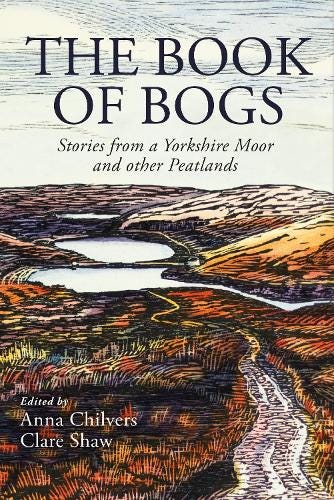
What have I been reading? I finished The Book of Bogs, a collection of essays, stories, poems and a little art focused on but not limited to Walshaw Moor in Yorkshire, home to Top Withens (the probable model for Wuthering Heights), home to the Brontës, but also peatlands threatened by a windfarm development. (More on that here.) Examining peatlands and moors through many lenses: botanical, hydrological, ecological, mythological, literary — it builds a layered portrait — a deep map — of a complex and often undervalued landscape, arguing strongly for an intrinsic value greater than the proposed windfarm.
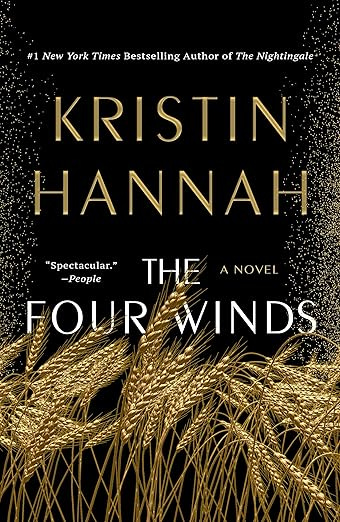
My head-cleaner novel — I actually took a day off and did nothing all one afternoon but read — was Kristin Hannah’s The Four Winds. Set in Texas and California during the Dust Bowl and the depression, it focuses on one woman’s fight to keep her family alive, first on a farm eviscerated by drought and dust storms, and then in the migrant harvest camps of California’s Central Valley. The Grapes of Wrath territory, you might say. I liked it; I didn’t love it, finding it a bit too predictable (although if you know little about this time in the history of the U.S, it’s a good introduction to the desperation and cruelty of the times, with some clear echoes of certain aspects of current events).
For more reading on the Great Depression and women’s lives, I recommend Coming Apart, by Karen Heenan.

This week’s song is about what too much winter and too much snow can do to a person: Stan Rogers’ Canol Road.
A free book promotion to Feb 2, 2026. It includes a prequel story that introduces my fictional world.
My Empire’s Legacy series can be found in e-book format only here:
https://scarletferret.com/authors/marian-l-thorpe
For paperbacks or other ebook retailers for all my books, follow this link to your favoured on-line store.
Thanks, Joanne. Surviving the winter?