
This Writer's Diary
August 9, 2026: Saskatchewan.

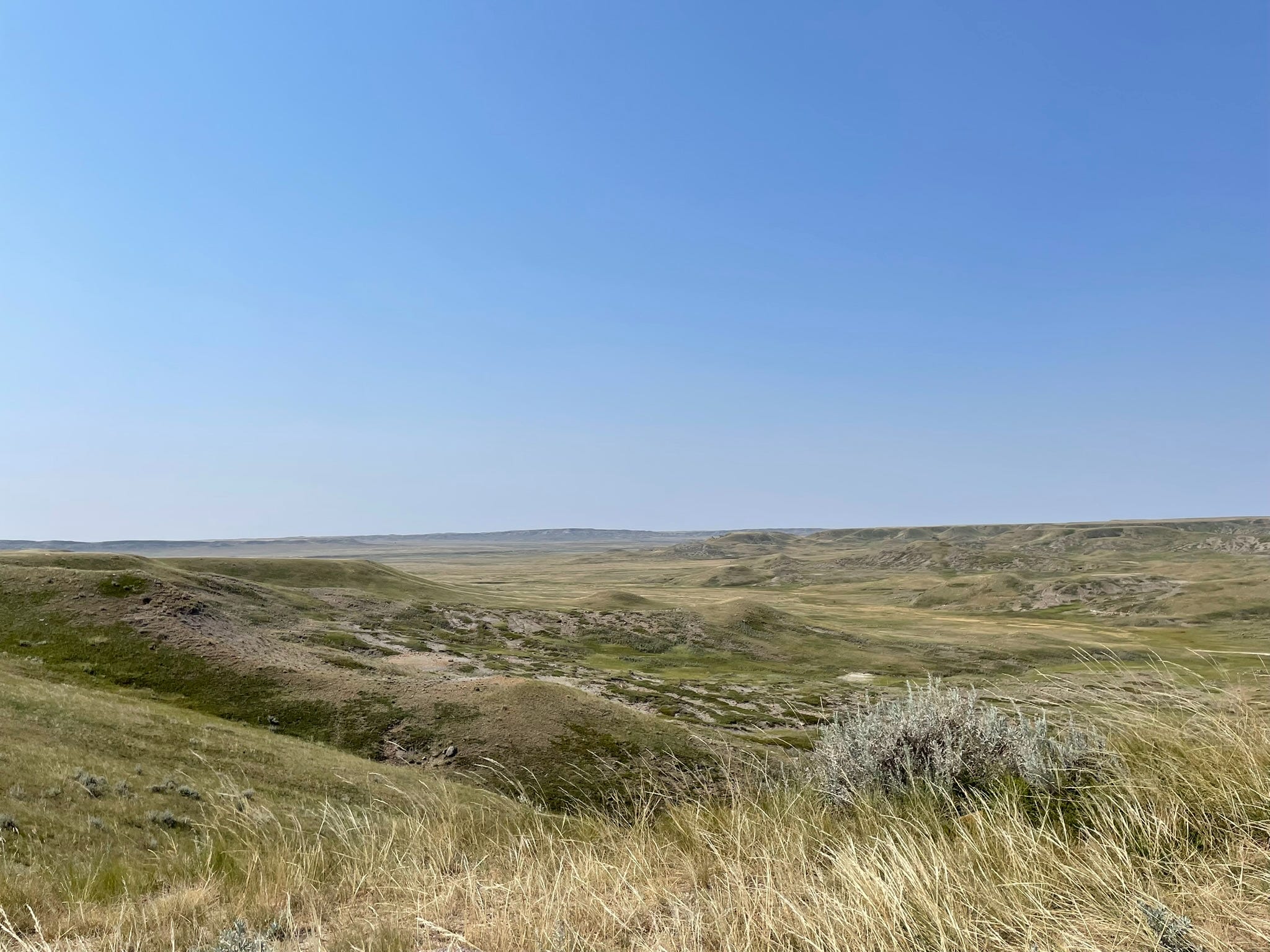
Friday morning – yesterday as I write this, two days ago (or more) as you read it – I stood on a path running through prairie. The trailhead was an hour behind me; I was alone. I could hear no cars on the gravel road several kilometers behind me, only the calls of Sprague’s pipits high above me in the clear sky. (If you can spare 23 seconds, watch the video below to see where I was.)
I’d come to Grasslands National Park in southwestern Saskatchewan in part to sort out what to do about writing. Bluntly, I’ve been discouraged; three years ago, my book sales were decent. Like it is for many other writers, indie, small press, or large press, they’ve dropped to very few. Here, under this relentless sky, as Wallace Stegner wrote in Wolf Willow1: ‘You become acutely aware of yourself. The world is very large, the sky even larger, and you are very small.’ Similar to my protagonist Lena in the Empire’s Legacy series, when I need to think, I need those huge skies and long vistas and the silence, except for wind and bird song, they contain. It helps with context.
Adding to this is my own (amused) question to myself about the current duology-in-progress: is a story focused on the personal, professional, and political crises of several forty-somethings and a callow youth trying to save the known (fictional) world’s greatest medieval library from destruction going to make anyone say: ‘I need to read that?’ Even with a love story or two thrown in, and a couple of battles?
I didn’t find an answer yesterday, walking or later driving through that vast landscape, letting the frustrations and the resentments work their way through my thoughts, watching Swainson’s hawks and prairie falcons, pronghorns and mule deer. But this morning I woke thinking about how field ecology and worldbuilding have so much in common: to understand how, say, that Swainson’s hawk fits into this landscape, the niche it holds in the web of life here as an apex predator, and how that is subtly different from the red-tailed hawks and harriers and prairie falcons and golden eagles it shares the grasslands with; what happens if its ‘living’ – the small mammals it relies on in breeding season – becomes scarce, or the trees it needs to nest are cut down. And then how all those things – competition, the availability of certain resources, weather, something demanding a change in living space – matter too to my characters. The ecology of the marketplace, in its broadest sense.
Something else happened on that drive yesterday, too. Heading east on Saskatchewan 18 towards Mankota, I entered a curve. On my right was a small stand of scrubby trees. This, I said to myself, is where I saw the swift fox cross the road. That was thirteen years (to the same week) before, on my last solo trip here. This happens with some frequency, as my amusedly exasperated husband will tell you: something in the landscape that he wouldn’t even notice triggering a specific, detailed memory. Even if I’ve only been there once.
Why does this matter? Because these memories become part of my worldbuilding and the landscape my characters inhabit, inseparable from who they are. Stegner, again: ‘Whatever landscape a child is exposed to early on, that will be the sort of gauze through which he or she will see all the world afterwards.’ Almost every place my characters inhabit or pass through in my alternate world is a place I’ve been, transmuted into the fictional lands of Linrathe and Ésparias, Beria and Leste and Cyrenne. My own deeply held love of landscape and place is transferred to my characters, shaping them.
It seems that this, rather that writing a memoir or some other form of non-fiction, is what I do with those memories and impressions and imperfect understandings of the places I’ve been. It’s why I cannot picture my characters without the landscapes that shaped them. It’s why setting, whether the coast of Anglesey which became Lena’s village of Tirvan in the first book, or the medieval merchants’ yards of King’s Lynn that are at the heart of the opening scene of An Unwise Prince, always, always comes first.
This may be among the oddest reasons to write, but there it is. It’s why I write. Not the only reason: parts of history are also transmuted; the ‘what if?’ at the heart of the duology I’m working on asks this question, relocated into my world: what if the destruction of Baghdad’s library at the hands of a Mongol general inspired an combined effort to save another, greater one under the same threat? (A ‘crusade’ of a sort, perhaps?) And then, inevitably, the people who come forward from my subconscious to be the actors in this tale develop into complex individuals with their own stories to weave into the larger one; stories that loop back to the places and landscapes and relationships that influence who they are. The world that built them.
My days under the prairie sky have solidified this understanding, making me realize that whether the books find a readership, or whether they don’t, is, at the heart of it, immaterial.2 I am, truly, writing them for me.
I do understand my viewpoint is one of financial privilege (and retirement): I have both the time and resources to be able to say this.
If this has piqued your interest, the published books are available in a wide number of places: Bookshop.org (with a variety of covers from the last 11 years!) the usual digital stores or, e-book only, from independent bookstore Scarlet Ferret.
I'm relieved to hear you found a reason to write, Marian. And writing for yourself is reason enough!
Interestingly, I find it most difficult to describe the settings on my fiction. I think of character, dialog, and action beats first, and though I establish a setting for context, the details don't come easily and I have to add more to the settings in revisions.
I was born and raised in the city (Toronto) and find urban landscapes most stimulating, as well as and the complete absence of city and trees in desert landscapes. Not sure if there's correlation between my familiar childhood urban environment and my fictional settings--urban settings can be overwhelming with many small details, which could entice me to only focus on the details that are relevant to a scene.
Saskatchewan looks incredible. I'd love to spend a few days walking around the National Park there.
I fully understand the way landscape, memory, relationships and events fold together. I think for some folks, it draws them to painting whereas others pick up an instrument. (For me, reviving old stories seems to be the thing that fits. No idea why.) I think it's more important than ever for people to continue to do this. It's likely going to have a strange, added kind of value in the near future as technology continues to influence our world. Like raising kids, volunteering at the fire station and a great many other things, it may not pay so great but it's terribly important work.