
This Writer's Diary
To May 19, and mostly birds again, plus a look at the new anthology.

A day late - the long weekend in Canada threw me off!
Thursday May 14th
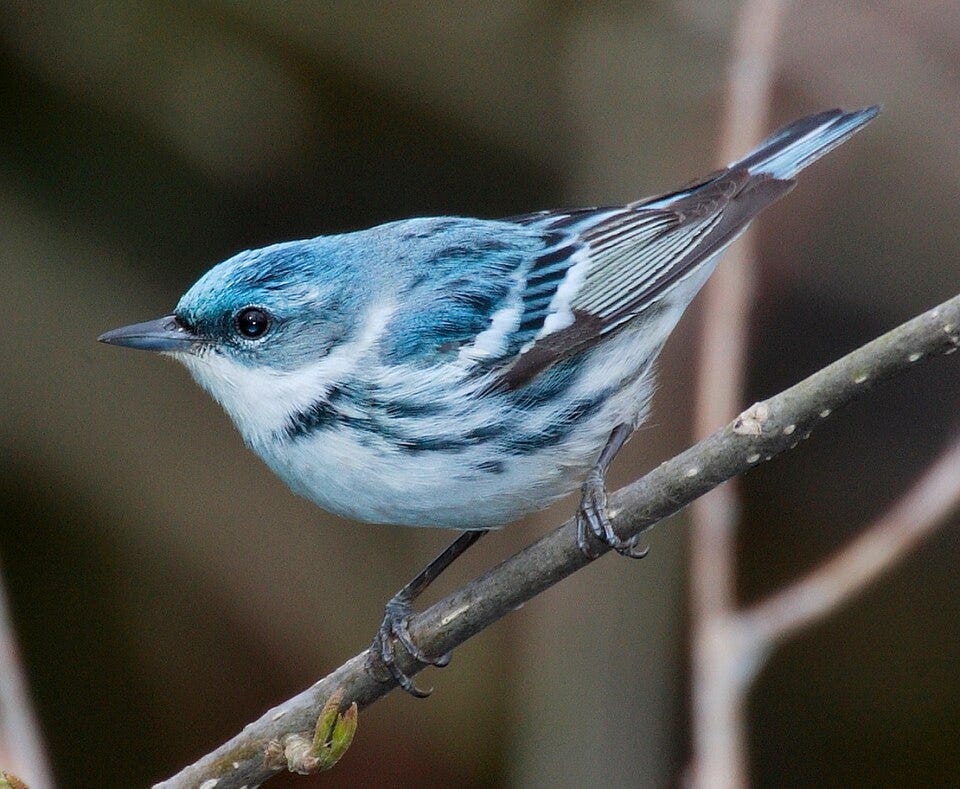
The Cerulean warbler fed low in the maple swamp. On this cool, damp morning, warblers searched for insects not at the treetops, but in mid-storey shrubs: black-throated blues, chestnut-sideds, northern parulas. A ‘fall’ of hungry birds, after a wet, cold night.
Or so I was told. After losing four days of May birding to a cold and three more to bad weather, I was getting ready to go out for the first time in a week. I bent down to pick up a pair of socks from the floor — and threw my back out. When I could straighten up again, even walking across the room hurt.
On, of course, the best day of the month.
Friday May 15th
By late morning, I was not in too much pain; I’d risk a walk. The Cerulean warbler was still at the maple swamp, along with far too many people to fit on the boardwalk, at least half of them photographers. (57 reports on e-bird today, and that’s only the people who use it.) I’ve seen a Cerulean warbler . . . no, not for some years, but I wasn’t going to add to the mob or risk an accidental push/shove/trip with a back that was just beginning to cooperate.
So I went off to a different, quiet section of the Arboretum, and saw the year’s first redstart, and the year’s first Swainson’s thrush, and a merlin chasing a turkey vulture. There were turtles and a garter snake, a damselfly (or maybe a small dragonfly); field sparrows sang and sang, background to a very loud blue-headed vireo. Pine warblers and chipping sparrows showcased their different buzzes, a kingfisher chattered over the pond in Victoria woods, and a myrtle warbler fed low in the shrubs.
I don’t need to see the Cerulean, but I’m happy it’s there. It’s the most threatened of all the wood-warblers, and even when I began serious birding 45 years ago it was a rare sight in migration.
Sunday May 17th
I sat today on a bench near the edge of the Speed River and just watched. Watched and listened. The side of the river I was on is a manicured park, but the bench was beside a pollinator garden. Across the river the bank is steep and covered in a thick growth of trees and shrubs.
The river is shallow here, crossed by weirs and littered with rocks. Turkey vultures hang out on its banks and on the weirs before the day warms enough to create the thermals on which they glide. Phoebes flit and swoop and perch, tails wagging. Northern rough-winged swallows and the occasional cliff swallow glide over the water and the gardens, hunting insects.
My back is improving, but slowly, which is why I’m sitting now instead of walking. Time to watch, time to think. I’m wrestling with a plot point, a change I made that I think needs to revert to the original, or become unworkable later in the book. But half my mind’s on the birds. The bleached leaves of some ornamental grass are shaking. A female Baltimore oriole is prising out strands for her nest in the mature maples lining the river.
I decide to make the necessary change in the story. From atop a curving flower frond, a song sparrow sings: ‘Pres-pres-pres-presbyterian’. Above me, in the tree shading the bench, goldfinches chatter. I hear the rattle of a kingfisher, and see a flash of blue over the river. My mind throws out a logical progression of thought and conversation between two of my characters, creating another plot wobble, but not one I have to deal with immediately. I’ll leave that one to my subconscious for a while. A white-breasted nuthatch scuttles up the trunk of a tree, examining the bark for insects. Finding nothing, it flies to another tree.
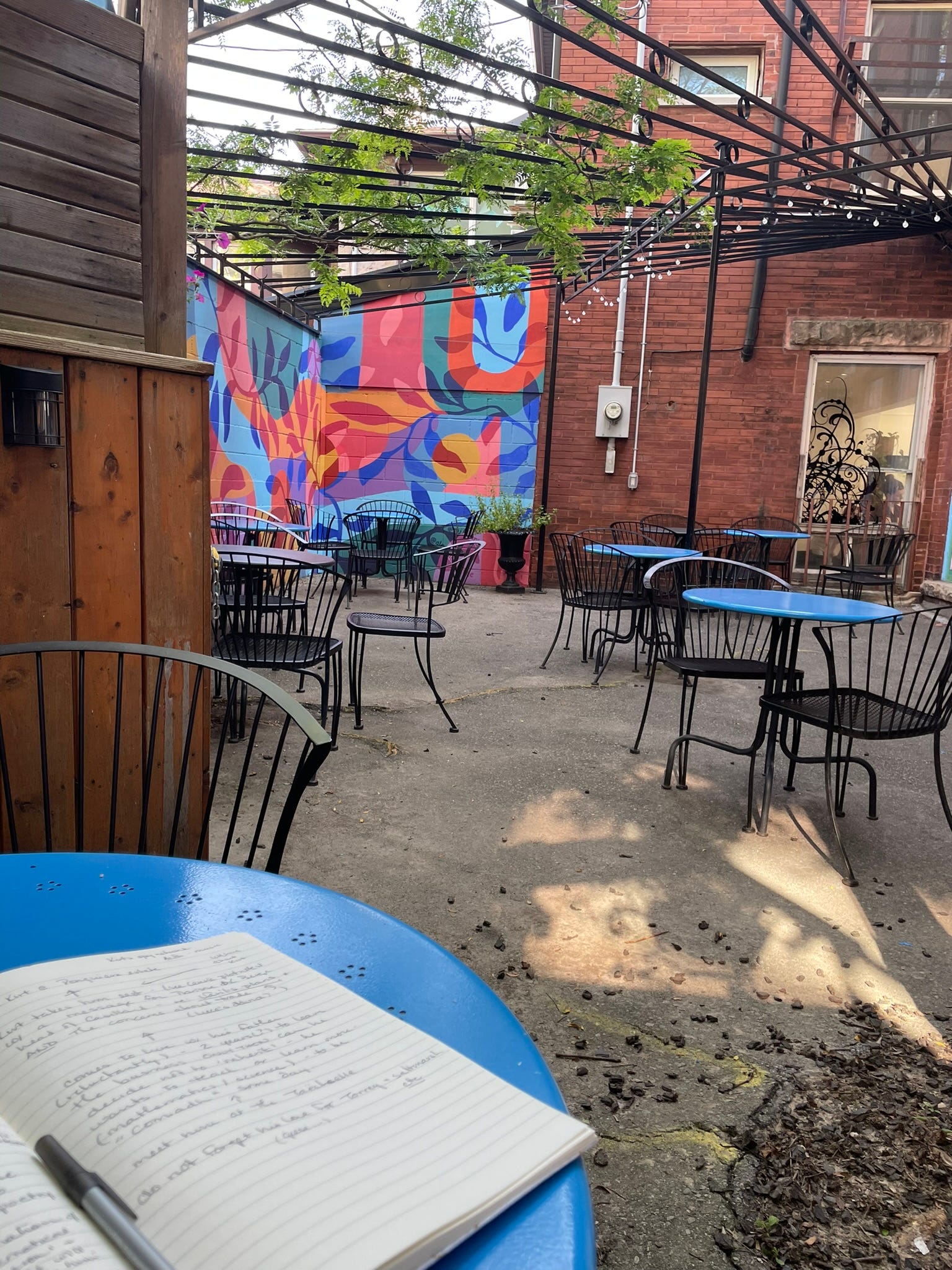
I write for an hour at my favourite cafe, outside on the patio for the first time this year. My plans to write more in the afternoon are derailed by a need to fix a technical issue for the community newsletter. But I know where the scene is going, so it will be easy to get back into it tomorrow
Monday May 18
It’s going to be hot today, a forecast 30C this afternoon, feeling like 35. But at 7:30 am the day is still reasonably cool, and there’s a breeze. My back is mostly better. I’m going birding.
I spend two hours at the Arborteum, seeing, for the first 90 minutes, almost no other birders (because they’re all at the ‘warbler trap’ of the maple swamp) and only one runner and one dog walker. The air is full of songs and calls: some new —Northern Parula, Black-billed Cuckoo, Eastern Kingbird, Eastern Wood-pewee — and a distant ‘Queeell’ call that belongs to the Red-headed Woodpecker reported yesterday. But the most interesting bit of the morning happened early.
A crow is repeatedly diving from treetop to the ground beside a double row of cedars, calling what’s clearly an alarm call. I can’t see anything in the long grass: a cat, perhaps, or a weasel? I decide to walk along the cedars on the other side. There’s a shape — a bird — maybe a young crow? But it’s too big. I focus the binoculars. It’s a red-tailed hawk, with something dark in its talons.
The crow continues its diving; the hawk moves further into the shelter of the cedars and begins to pluck its prey — which is clearly, now, a fledgling crow. What struck me as odd about this interaction was the last time I came across a red-tail with a young crow as its prey, it was being mobbed by at least two dozen adult crows, screaming and diving and generally making the young hawk’s life a misery. But this adult crow was alone, and no one was flocking it its aid. Had the fledgling been snatched an hour or more past, and the other crows given up the harassment, leaving only (assumedly) one parent to expend energy on a hopeless task? That’s my guess, but it is only a guess.
I’m home by 10 am, ready to return to work on An Unwise Prince.

The Courage anthology comes out on June 17th; preorders for the ebook are open on Amazon. Here’s just a taste of my short story, ‘The Phoenix’, set twenty years after the end of the last book of the Empire’s Legacy series, Empire’s Passing.
The envoys arrived late on a spring afternoon, asking to see me immediately. I gave them the courtesy of an audience, but only to greet them. Two men, one grey-haired, the other younger, both travel-stained and weary. Their message, I said firmly, could wait until tomorrow. In the meantime, there were baths and wine, comfortable beds, a quiet meal in their rooms.
I told them all this with my throat tight and a sense of cold creeping along my spine. Of all the places these men might have been from, Halachia was not one I might have expected.
“But, Principe...” the younger began. His older companion put a hand on his arm.
“Not now,” the grey-haired man said. “The Principe has told us she will hear us tomorrow. Nothing can happen tonight.” He bowed his head to me. “I apologize for my nephew, Principe. He is here as my secretary, but he is inexperienced in court protocols.”
That was no surprise. How could he be? Halachia had been under Kidari rule for nearly twenty years, and the Kidari, who had swept into the lands at the eastern end of the inland sea to conquer not just Casil, but almost all the small countries that had been provinces or client kingdoms of Casil’s empire, did not allow the subjugated people of those lands much participation in governance. But if these men were here, it meant something had changed. I needed time to consider what that might be, and the implications for three people here in my little country bordering the western sea.
I had an advisory council, men and women to whom I could take my concerns. But there was only one person whose advice I wanted now: my brother’s. For almost twenty years, I had turned to Colm first when problems went beyond the day-to-day governance of Ésparias. When Casil had fallen and Colm had returned home, I’d been clear with him. I needed him with me, for support and advice. He had his own responsibilities, and not small ones: the school of medicine and more he had founded took most of his time and energy. Men and women from around the known world came to study or teach here; lectures were given, treatises written and translated, students encouraged and disciplined. But if the reason these two men from Halachia were here was what I thought it might be, then I needed Colm’s thoughts more than ever before.
If you don’t know the writers involved in this anthology, you can read reviews of one of their previous books by following the links below to the blog of Patricia Fustenberg.
https://alluringcreations.co.za/wp/exsilium-by-alison-morton-when-civilisations-fray/