

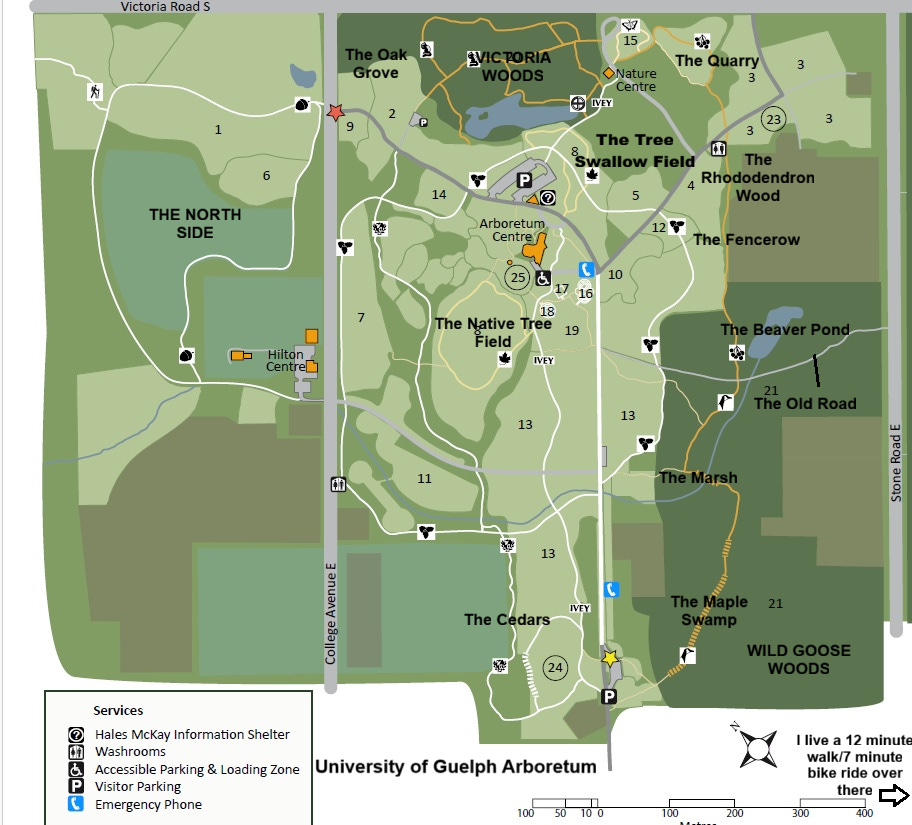
I’ve decided to include the map in all weekly posts, at the end, so those who’d like to refer to the places I’m talking about can do it more easily.
September 28
High in the distance the warble of a sandhill crane reaches my ears. Were it not Sunday morning I doubt I’d have heard it; weekdays, the traffic noise is too loud. It’s somewhere to my east, not visible. There is something about the call of a sandhill crane that tugs at my heart. Unless the the similar sound of a European crane lies deep in genetic memory, there’s no clear reason for this: they aren’t a bird of my childhood. Sandhills are passage birds for me here, heard and seen only in migration. (At our previous house, 23 km southeast in a rural area, they nested in a dense marsh about 5 km away, sharing the space with American bitterns.)
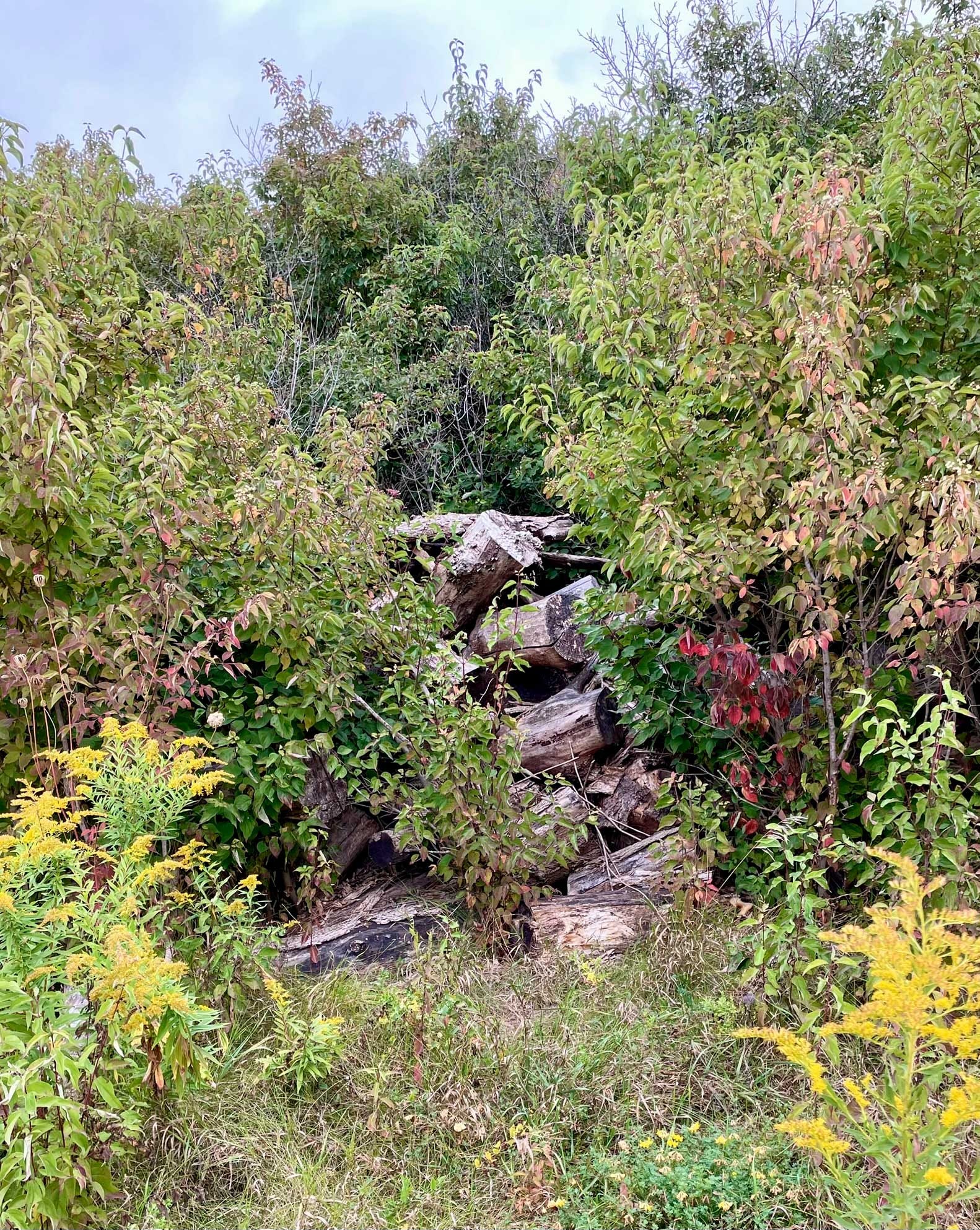
A dogwood hedge, possibly grown up around an old fence row, is alive with migrating warblers: Tennessee, Nashville and a chestnut sided. A black-and white warbler forages in nearby pines. It’s a still morning, so still that even the poplars are quiet. Underfoot, I scuff leaves as I walk, and most of the movement that catches my eye in the canopy is falling leaves.
Cedar waxwings explode from the trees. Why? The answer zips across the field: a merlin. A red squirrel bounces across the path, jaws clamped around a black walnut. Once it reaches the safety of a tree, it somehow manages to chirr at me, nut still in mouth. A dragonfly, red bodied, blue winged, hovers and lands, hovers and lands, not resting long enough for a photo. The day feels like fall, but not quite. By early afternoon, the temperature is in the mid-20s.
September 30
Thud! Another black walnut falls. All along the path the detritus of the forest floor is pocked by squirrel excavations, each a cached nut for winter food. At the intersection of two paths a tree is crowded with birds: a juvenile hairy woodpecker, still more brown-and-white than black-and-white; chickadees, white-throated sparrows, a warbler I can’t identify – or is it a vireo? I see it once, briefly. Why this tree? Likely because it’s taller and stands where the morning sun hits it, bringing insects out of their overnight torpor.
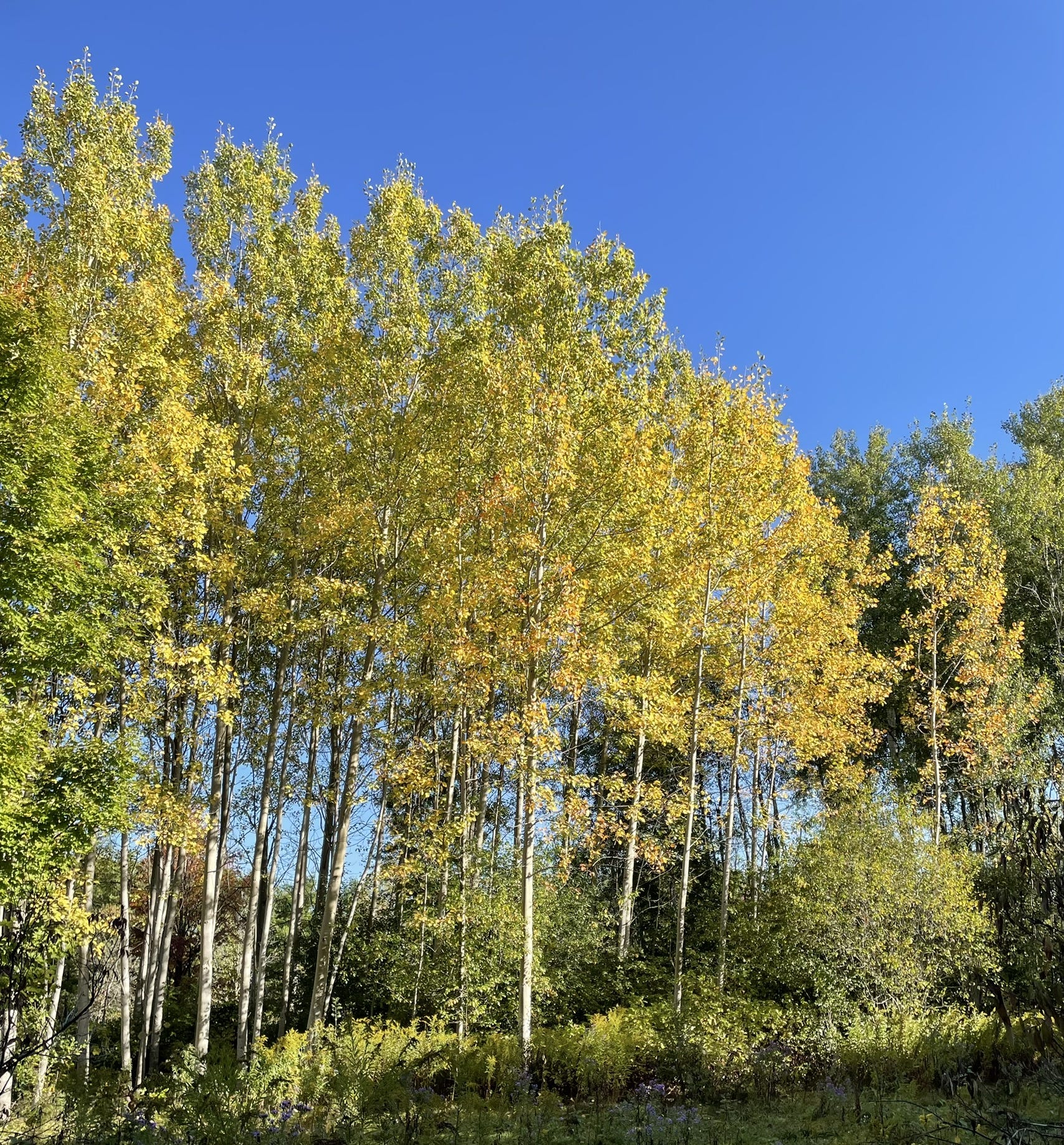
A bit further along, where a gap in the cedars gives a view over an area of old field succession, the scent of drying grasses reaches me. Not quite the smell of drying hay, but subtler. Fleeting, with more notes than just grass. (I sound like I’m writing a wine review!) The poplars are turning yellow now, and every light breeze brings down leaves to pattern the path. There’s a catbird mewling in the dogwood hedge and across the field, a flock of cedar waxwings are feeding on the purple berry-like cones of an eastern white cedar.
At the beaver pond, a green heron launches itself from a dead tree as I approach. I sit on a log to wait and listen. A steady rain of willow leaves falls: one bounces off my nose.
The beaver pond started life as a man-made irrigation dugout, I’m fairly sure. There’s an old pumphouse on its east side, with some pipes still in place. The fields to the east were a tree nursery once; I’m not sure of its history, but from the age of the trees that still stand in neat rows I’d say it was planted about when the Arboretum was begun. Along the north edge of the old tree nursery is one of the few visible remnants of probably the first European settler activity: a collapsed boulder wall edged with a split rail fence. It runs westward into a small maple swamp, and east to the edge of a small pinewood once planted to rhododendrons.


But just north-east of the pond, where the path turns to run up through the woods to the old boulder wall, the ground cover is European ivy, with patches of lady’s bedstraw, both non-natives. There are daffodils here in the spring, too. Which makes me wonder if there was a house here once, perhaps a log cabin? Something to be investigated using the old maps in the university library.
The scent of damp soil and leaves beginning to decay underfoot has brought back memories of the first woodlot I explored as a child. A woodlot whose paths and trees, ephemeral ponds, patches of violets, pieces of rusting machinery at its edges, I can all still see in my mind’s eye, although they no longer exist in real time. I’ve written before about how my father at 80 unerringly found his way across a treed common, a path he hadn’t walked in 67 years, following the map in his head. The fields and woods and paths I walked as a child now lie under houses and lawns and swimming pools, but the memory of how to navigate them remains.
Because I’ve experienced the gradual change at the Arboretum over the last 45 years, I don’t have those memories of what used to be. The mental map from 1978 or 1990 or 2000 has been overlaid, obscured. It’s a bit like knowing my husband had a head of long, wavy, dark hair when I met him, but the man I live with now is both white-haired and half-bald. I saw the gradual change, but I can’t say when it happened.
October 3
The world sparkles. It was 6° overnight and there’s a heavy dew at 8:30 a.m. It’s still cool enough I can see my breath, and mist rises where the sun’s warmth reaches wet grasses. In the rehabilitated gravel pit, known to me as ‘the quarry’, the underbrush is full of birds. Among the sparrows and thrushes I hear the high notes of dark-eyed juncos, returned from the north to winter in a more hospitable place. Every year, October and juncos arrive together.
October 4
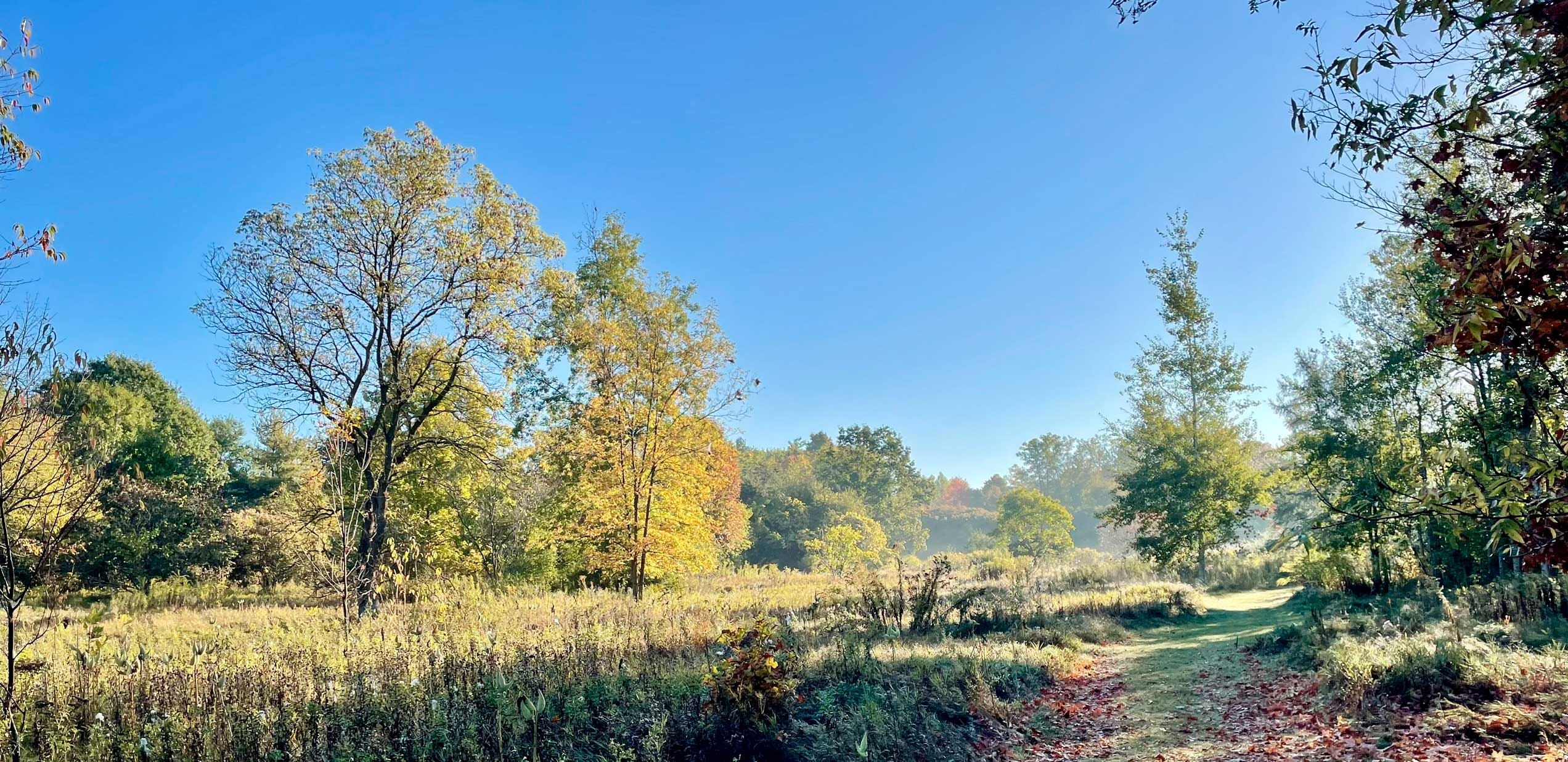
Unusually, I’m at the Arboretum only a few minutes after sunrise. There’s only one other car in the parking lot — birder or dogwalker — and it’s very quiet. I’m hoping for mammals, but other than squirrels I’m out of luck, although at the beaver pond something unseen slips off a log with a splash. Mink? Muskrat? I was facing the rising sun, and didn’t see it.
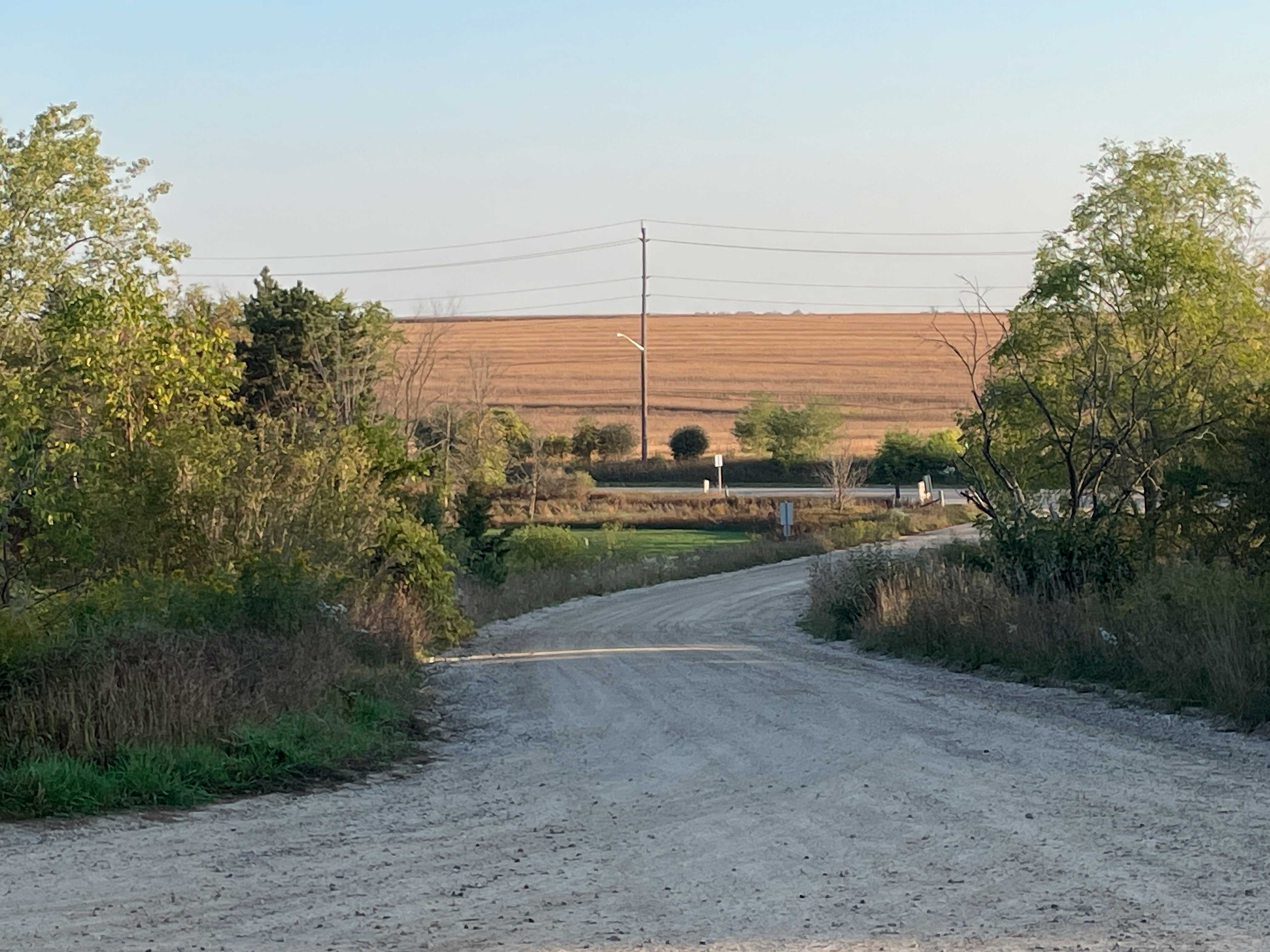
Writing these diary entries is making me look more closely, and differently, at this place I’d have said I knew well. (I wish we had the equivalent of Ordnance Survey maps, but we don’t.) If you’d asked, I would have said the Arboretum was ‘fairly flat’, but today, having followed an interior road a bit further than I usually do, towards a house I barely knew was there (And why is it? And who lives there?), I realize how high the piece of land I’m standing on is. The slope to the north is steep. To the east the land drops, then rises again on the other side of Victoria Road. That’s farmland now, but in a couple of years it’ll be houses, a lot of them, and the pressure on the Arboretum as recreational green space will increase. Which is perhaps one of the reasons I’m writing this now.
As I’ve said elsewhere, I’m currently reading The Salt Stones: Seasons of a Shepherd’s Life, by Helen Whybrow, a book that’s making me think a lot about attachment to a place. Here in Canada my attachment to the Arboretum is born primarily of a love for nature. With no family history in Canada, I had to build my own relationship with the place I lived, and I did it through doing my best to understand the natural world that surrounded me: flora, fauna, geology, topography, climate.
My love for west Norfolk is different, born of family stories and histories, but also from the long, visible and invisible history of migration and settlement and change: the bronze age barrows and iron age ‘hillforts’; the Roman roads and buried villas; the history I can read in the Domesday Book and see in the churches and houses and roads, a history that speaks to me. (And then, of course, there are the saltmarshes and the huge skies, and the birds, the pink-footed geese overhead, the waders on the Wash, the tits and finches in the hedgerows . . .)
Two places, both home, but one I take much more for granted. I’m trying, with this series, not to.
If my fiction is of interest, you can read my short works in my Substack Story Archive.
Find (almost) all my books at https://scarletferret.com/authors/marian-l-thorpe, and all of them at Arboretum Press.
Donations for my local foodbank gratefully received.
I’m finding this very interesting Marian, and you’ve got me thinking about the woods I played in as a child. If I went back to them now, could I still navigate the footpaths as I did back then. I reckon I might but I don’t know for sure that they are still there. Thank you for sharing.
I love maps!! Thank you