
Fog and Stars
A ghost story.

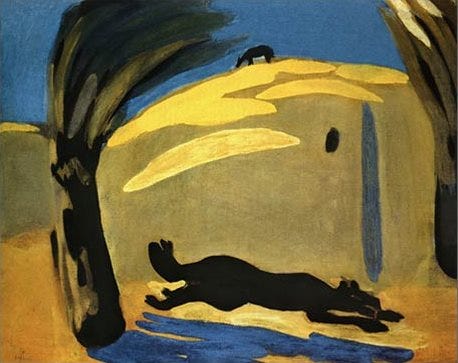
A hundred times, I’d say. A hundred times at least I’ve walked the old way to Gayton, over the high land that rises south of the Babingley’s valley. What’s that, Jimmy? No, not the Roman road, the old track that crosses it, just by the Harpley cottages. A fine night it was, too: no moon to speak of, but the Milky Way like a thick streak of whitewash across the sky, and the stars glittering. A good night for walking, and so I started out. The first time without Captain, it was.
Get another dog, you say? Yes…yes, perhaps I should. I’ve some good years ahead of me yet, I hope, and maybe come the spring I’ll see who has Norfolk terrier puppies for sale. I’d like the same breed. But that night – it was last Thursday – I stepped out alone. I’d gone some distance when I thought the stars started to dim a bit, as if a light cloud was drifting in. But it wasn’t cloud. That’s right, that was the night the fog came in so heavy off the sea. All that way inland, too, a good ten miles. Uncommon, that.
I wasn’t worried. I knew if I kept on another half mile, I’d come to a wide bridleway. The one to Massingham, yes. Turn left there and in twenty minutes, that’s all, I’d reach the Roman road. I couldn’t miss that, even in the fog. Turn left again, keep to the road, back to the car in forty five minutes.
I was more worried about driving home, but it’d be near midnight before I reached the car, and there’d be few other vehicles, if any, out on the lanes so late. I’d just drive slowly, with the fog lamp on. Cautious and canny, my old mother would have said, God rest her soul. How long? She died some twenty years back, when you were over in Wiltshire doing your National Service, remember? A Yorkshire lass, she called herself, come down from the north to work as a herring girl at Lynn. Always said she felt right at home here, with all the villages with names like those up north, and some of the same words and legends her granny had taught her. Yorkshire and Norfolk, and the counties along this east coast were all ruled by the Danes once, you know. King Canute, yes, that’s right, proving he couldn’t stop the tide. Do you remember learning that story in school?
He couldn’t have stopped the fog that night, either. So thick it was, I couldn’t see the hedges that were no more than an arm’s length away. I began to think I wouldn’t drive home, just wait the night out in the car. There was an army blanket on the rear seat, put there to keep Captain’s muddy paws off the fabric. I hadn’t taken it away yet. I could wrap that around me and be warm enough.
I won’t say no to another pint, thanks. Ah, that’s good. So I kept walking. But fog changes things. Distorts them. Distances and sounds. Shapes, too. For all I’ve walked that land a hundred times, I still made a wrong turning. What told me I was wrong was the feel of the track after a while. It became sandy, instead of hard and flinty. I called myself a fool and worse, let me tell you – I see that grin, Jimmy – but I knew where I’d gone wrong. I’d veered right at a fork, instead of keeping on straight ahead, and now I was on the heath.
Captain loved that heathland, full of rabbits and more, but you need your wits about you walking there even in daylight. Not just rabbits burrow there, and more than once I’ve twisted an ankle in a hole I didn’t see, hidden by the heathers. Then there’s all the places men have dug out sand for mortar. But it was none of those dangers that made me suddenly cold, standing with the fog wrapping me like a shroud.
I’d never given my mother’s stories much credence, and if you’d asked I would have said I’d forgotten most of them. But I knew where I was, fog or no, and I knew how far I was from farm or cottage, and when I heard a dog howl, close, I didn’t think of some town animal lost on a walk earlier, or even a farm watchdog that had slipped its collar and run loose. What I thought of was her tales of the black dog.
That surprises you, that my mother talked of the black dog of heath and track? The Barghest, she called it. Here it’s Black Shuck. Seems like wherever the Vikings – or Danes, call them what you like – ruled or raided, they brought that story with them.
Jimmy, lean in a little closer. I don’t want the whole room to hear. We’ve known each other since our first days at school, and I’ve never lied to you, have I? No. Nor am I now. So – listen. None of your jokes.
I saw the black dog.
I saw the eyes first, like glowing coals burning through the fog, coming towards me. Then the shape: a dog, but the size of a red deer stag, I swear. And the sound it made – half growl, half howl. I couldn’t move. I was frozen, cold as death, my feet as heavy as iron. I thought I was going to die a grisly death up there in the fog.
And then another dog barked, and barked and barked and, Jimmy, it was a bark I knew, Captain’s bark, the one he used when a fox trespassed in our garden, or he didn’t like the look of a salesman at the door. But fiercer than I’d ever heard before. I saw – no, felt – something pass me, and then ahead of me in the fog the sounds of two dogs fighting.
I don’t know how much time passed, me, still rooted to the ground, listening to the snarls and yelps, sometimes seeing the two bodies – the huge and the small – grappling on the path ahead, in and out of the fog. Then a last howl, from the black dog – Captain never howled – and the noises stopped.
I found I could move again. I took a step forward, calling Captain’s name. He barked – Jimmy, I swear this – the little yip he always made to greet me – and again I felt something brush by me. He yipped again, and I turned and followed. And that’s how I got back to the Roman road, following those little sounds. By the time I got to the car I couldn’t have driven for the life of me. I crawled into the car, wrapped that blanket that smelled of mud and dog around me, and slept.
I woke in the grey light of early dawn, cold and aching. The fog had almost gone, just wisps hanging low along the hedges and fields. The stars shone overhead, and on the Roman road a dog stood, as if guarding me. A Norfolk terrier.
No, Jimmy, listen. I know they’re common dogs here. I’m not done. He didn’t move, just looked up at me, and his eyes weren’t a dog’s eyes – they were like pieces of the night sky, black but full of stars. That – well, I’d got out of the car, but it made me freeze again. Then I had to put a hand on the car to steady myself, because he faded. Faded, Jimmy, like fog melting into the air, and even though he’d been on the track I swear there were stars where he’d been – as if they were caught in his coat, or were in his blood or bones – and then they too were gone.
Yes, you might be right. It might have been a dream. I’ll have a whisky now, I think – one for you too? – before I go home. If you’re ready to go then, we could walk together. It’s dark out. I’d appreciate the company.
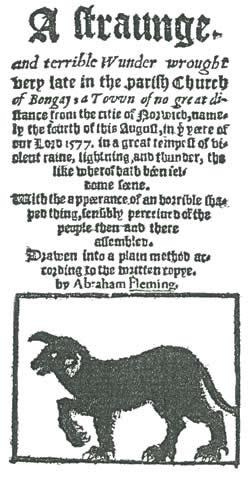
"A straunge, and terrible Wunder wrought very late in the parish church of Bungay: a town of no great distance from the citie of Norwich, namely the fourth of this August, in the yeere of our Lord 1577. in a great tempest of violent raine, lightning, and thunder, the like wherof hath been seldome seene. With the appeerance of an horrible shaped thing, sensibly perceiued of the people then and there assembled. Drawen into a plain method according to the written copye. by Abraham Fleming."1
‘Black Shuck’ is one of the names given to the ghostly black dog of East Anglia. W. A. Dutt, in Highways & Byways in East Anglia (1901) suggested that ‘his story is nothing but the old Scandinavian myth of the black hound of Odin, brought to us by the Vikings who long ago settled down on the Norfolk coast.” 2
There are black dogs in the folklore of almost every county in England, so the link with the Vikings is doubtful - but it is notable that only Black Shuck and the Barghest of the north are (usually) malevolent. (Plus Odin didn’t have a black dog; he had two wolves, Geri and Freki.) But for the purposes of this story, I had my character make this link.
Find my books at https://scarletferret.com/authors/marian-l-thorpe or most on-line bookstores.
Adams, Abraham (1577). A strange, and terrible wunder. London. via https://en.wikipedia.org/wiki/Black_Shuck#cite_note-13
I love the natural voice of the author! And I've always had a soft spoke for folklore. Thanks for sharing this.
The point of view and narrative voice mad for a fun read! A fine interpretation in my opinion, and quite suitable for a bar tale. Nicely done!