
This Writer's Diary: Ten Weeks
Week 3

Sunday Feb 22
We return to Courtyard Farm again. It’s a good place to walk in the gusty winds: easy to choose a route that keeps the wind mostly at our backs, and many hedges and shelterbelts.
Bisected by the Burnham Road is Ringstead Common, comprising, in the Ordnance Survey screen shot below, the roughly rectangular field below the parking P. When the Ringstead area was enclosed1 in 1781, this area was set aside for ‘Poors Firing’: a source of gorse, used as fuel for bread ovens and fires, as well as a sand and stone pit for building materials.
The Common — which is now rented by Courtyard Farm from the charity that administers it — is about 2 km from Ringstead. Quite a distance to walk to find fuel, was my first reaction — but then I realized that pre-enclosure, when this land was farmed in hundreds of small strips of land, with rougher areas given over to grazing, that walk to and from the fields was part of daily life.
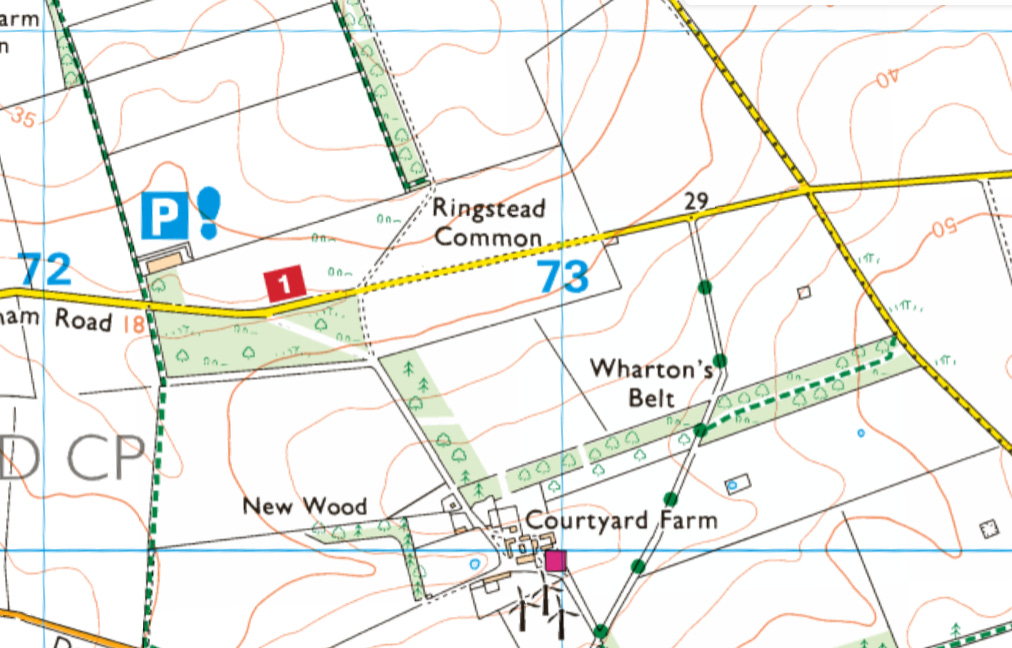
There are not a lot of birds around today, the winds keeping them in sheltered areas. But it’s a lovely day, temperature about 13C, blue skies: it feels like spring.
Monday Feb 23
Today is a village day for me, starting with coffee and cake at the cafe just down the street. (Our cottage is in a ‘dangerous’ position, with two pubs nearly on either side of us, and the cafe just a little further along.) Blackthorn is flowering, and greenfinches are buzzing away.
St. Nicholas’s2, the 14th-15th C parish church (Church of England) is also close. My great-grandparents are buried in its mossy, mole-softened chuchyard, among swaths of snowdrops. I wander around the churchyard for a while, looking for the gravestones and waiting out the mother-and-baby group that’s meeting inside. I can find my great-grandfather’s stone, lichen-covered, close to unreadable, but the not my great-grandmother’s: I know roughly where it is, but in that shadier section frost and rain, lichen and the permeability of limestone have had their way, and the stones are no longer readable.
Sometime in the last year, the churchyard wall that was sagging in one place has crumbled. A man is rebuilding it, slowly, patiently, placing the tumbled carrstones back into mortared rows. I wonder how old the wall is, and how often it has been repaired over the centuries.
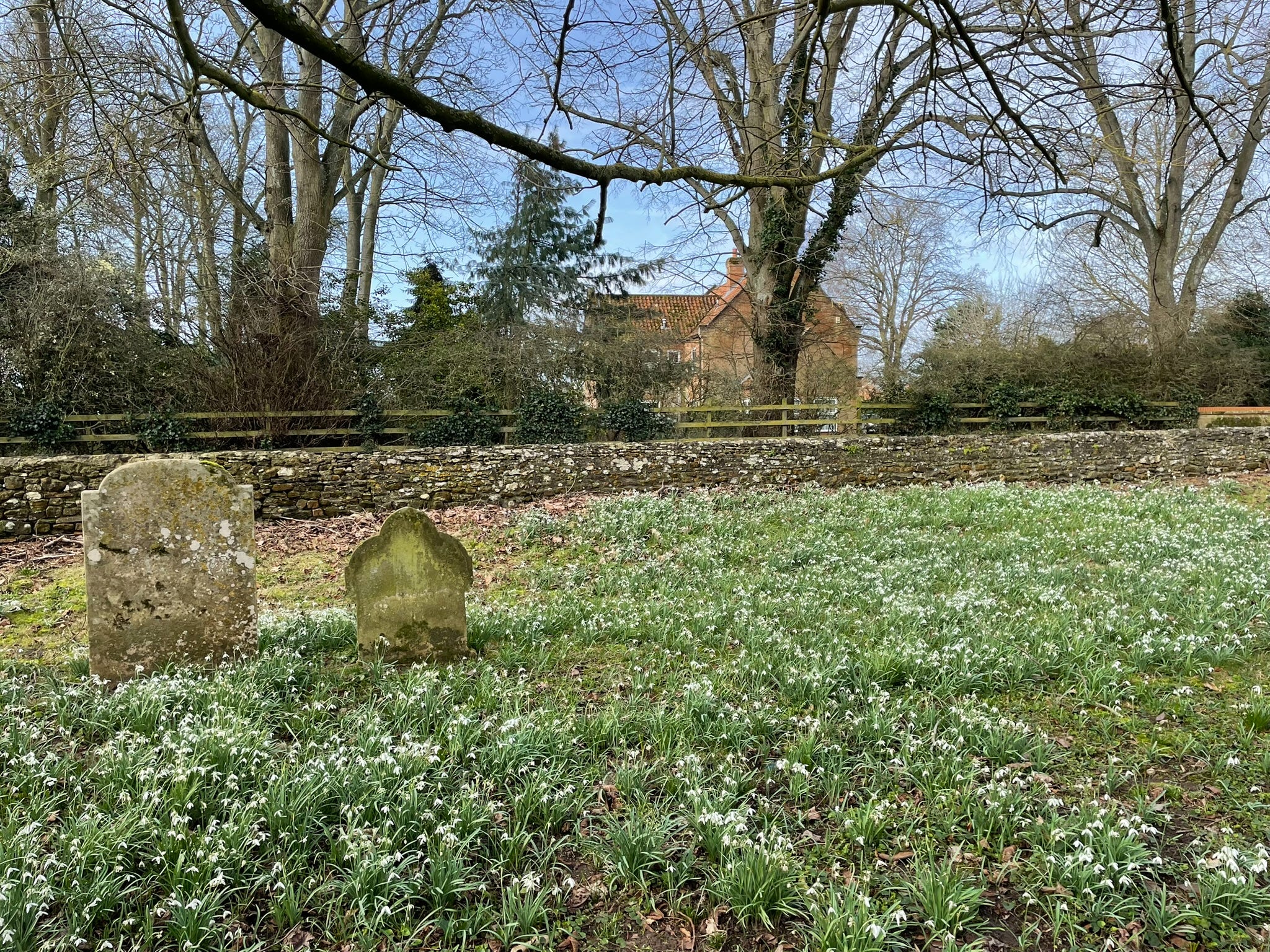
The churchyard is full of birdsong: blackbirds and tits, robins, dunnocks. Later in the day I walk to the shop in a light rain, and see my first house sparrow. On both sides of the Atlantic, populations are declining and have been for decades, for a myriad of interacting reasons. Here in the east of England, the decline is greatest. I’m pleased to see even two.
Tuesday Feb 24
Still windy, but warm with it — and I want the sea. Sea and strand, saltmarsh and grazing marsh. Thornham it is. (I wrote more about this place I love here.)
We walk the sea-defence dyke west towards the bird reserve at Holme. The wind is strong, but the wet pastures are full of wigeon and curlew. A flock of black-tailed godwits rise and swirl over the open water.
On the long pond known as Broad Water, little grebes and coot mix with tufted ducks and pochard. I stop for coffee at the visitor’s centre (and to examine the bookshelves), then walk a path where a multitude of common toads are gathering to mate, many of the females already carrying the smaller males on their backs as they travel towards the ponds where they will spawn.
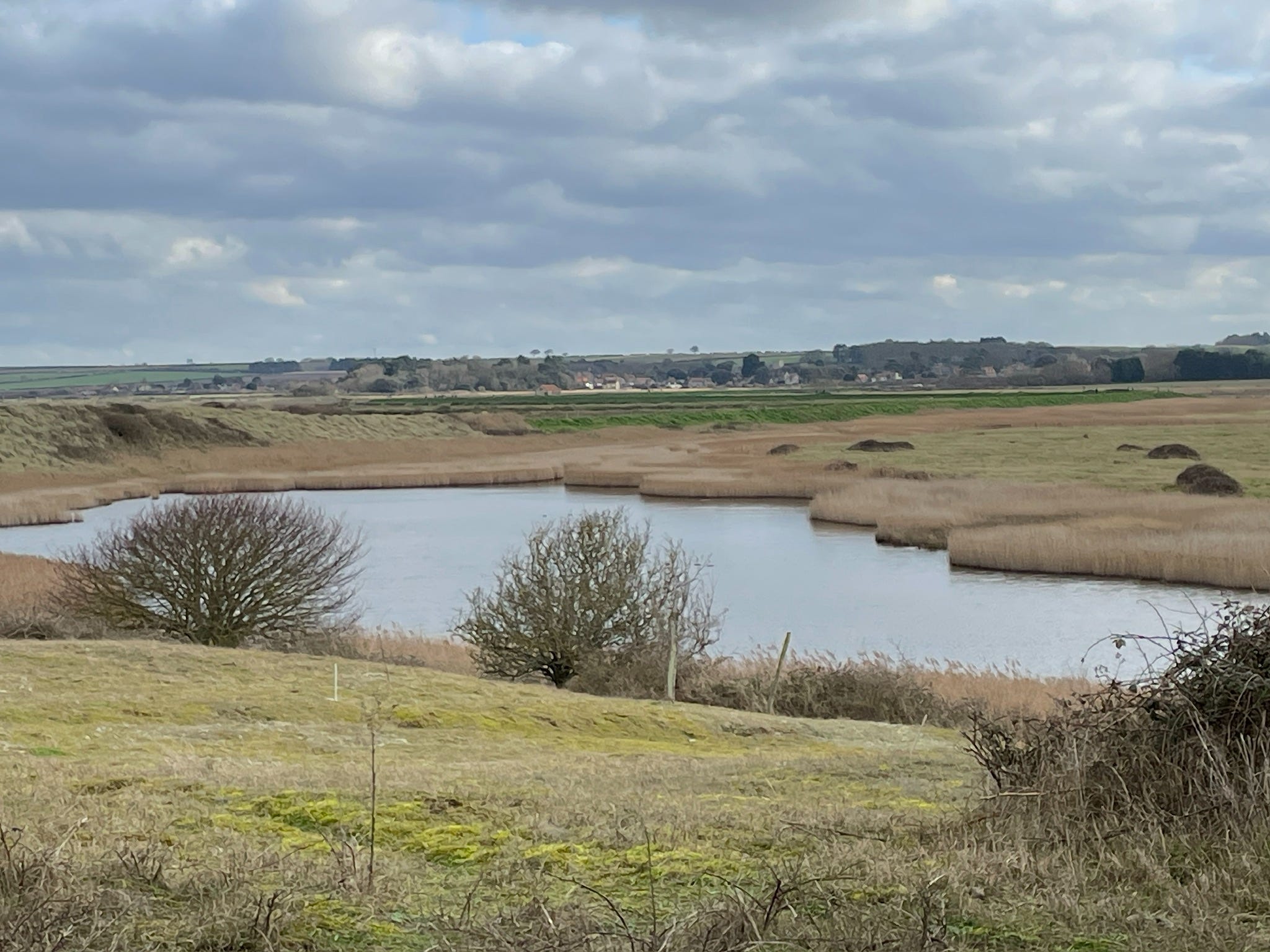
Out on the grazing marshes are gatherings of geese: mostly greylags and pink-footed (my favourite winter visitor to Norfolk), but in among them are a dozen or so Russian white-fronted geese, and two barnacle geese. We’d heard rumours of the white-fronts, but there had been no report of the barnacles: it’s always a special pleasure to find an uncommon bird that no one has told you about. Pleased with the geese sightings and the lovely day, we retrace our route to the car. A greenshank feeds in the tidal channels; out on the tideline there are sanderlings and oystercatchers and Brent geese. A five goose day.
Wednesday Feb 25
Another warm day, and another day for the sea, this time at The Wash. We arrive at the beach at Snettisham about forty minutes past high tide. Out on the mudflats oystercatchers and curlew feed in large groups; closer in are redshank and ringed plover. Something puts the golden plover up, and they wheel and glitter in the sun.
We walk the circular path around the RSPB reserve, stopping at the hides to see what’s in the old gravel pits. A few years ago to see a Mediterranean gull here was cause for excitement; now there are at least a dozen in among the black-headed gulls. A lone turnstone forages along the gravel of the edge.
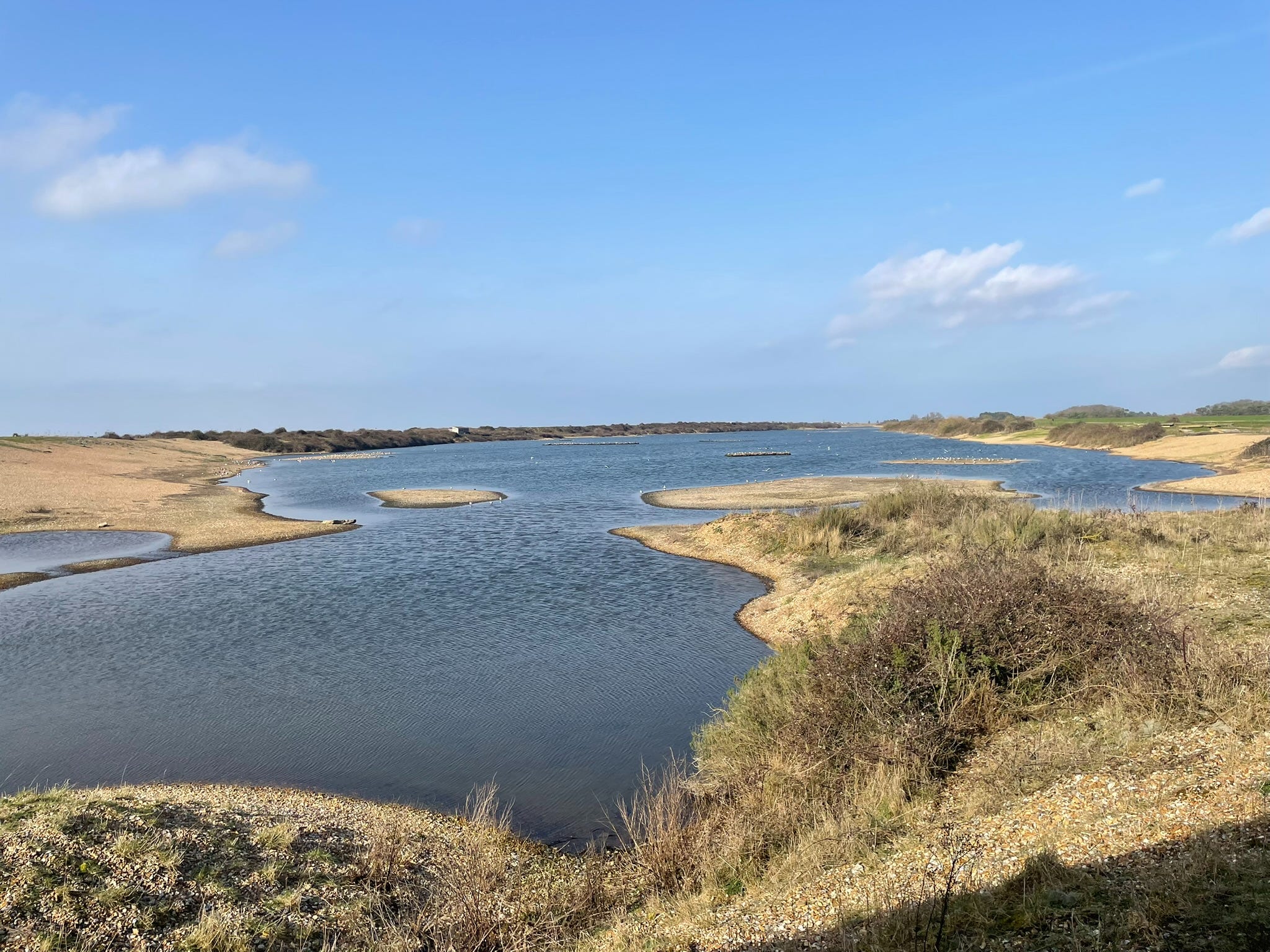
After the last destructive floods here, a new, ‘flood-proof’ hide was built. My name’s on it, among the others who made donations. Mine was made not just for the reserve, but as a nod to the simple wooden ‘bungalow’ my great-grandparents had on this stretch of beach in the interwar years. Ironically, I don’t really like the design of the hide, and rarely use it.
Where the path turns inland at the edge of the reserve, the Norfolk Coast Path now extends to King’s Lynn, along the seawalls. I want to walk it, just once. But it’s 17 km, with no ‘escape routes’. I’m not sure I can do that now.
At the carpark we shed jackets — it’s 16C — and walk north to the seawall bordering the Ken Hill3 estate, now managed for wildlife. In the freshmarsh, among greylags and mallards and wigeon, Russian white-fronted geese are grazing. We watch them for a while before turning back.
Thursday Feb 26/Friday Feb 27
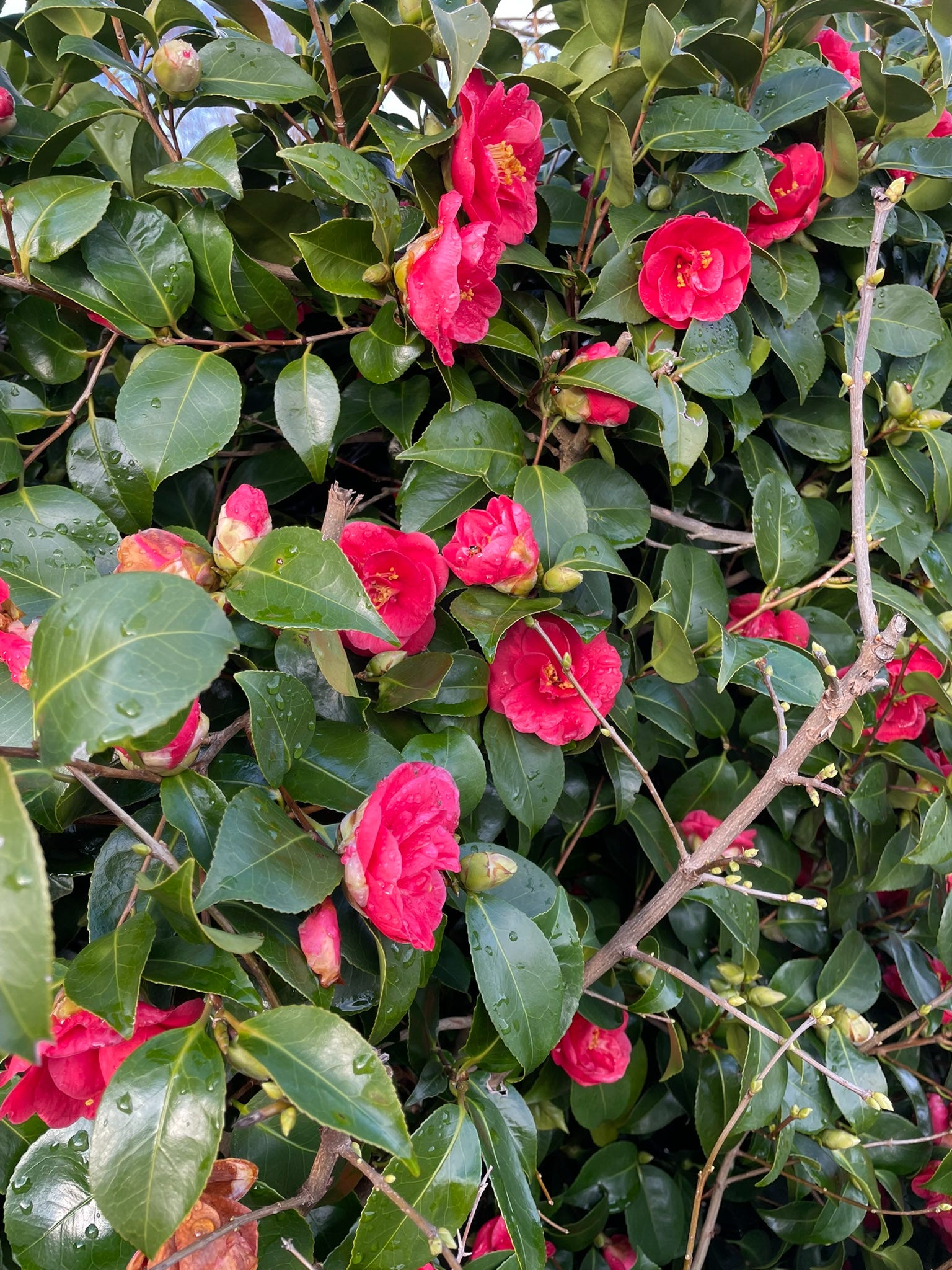
Two days that almost blend into one, except Thursday I was in Ely and Friday in Dersingham. But I spent most of both days writing: the short story for the ‘courage’ anthology was due, and I had to finish it. And trying to get back into the heads of characters I left behind in 2024, and who, in this story, are nearly two decades older, was a challenge. The balance of exposition and narration was also an issue . . . but other than polishing, it’s done. At least on Thursday I had a pleasant walk from the train station up to the library and back again. Friday it rained almost all day, although we did manage a village walk late in the afternoon, with robins and dunnocks singing in the patchy sunshine and two red kites circling overhead. And there was camellia in flower!
Saturday Feb 28
In the early afternoon the sky clears, and the weather map suggests we have a couple of hours before the rain starts again. We go back to the Houghton Hall walk, a shorter version this time, given the small window of clear(er) skies.
The footpath that runs through the wood called ‘Bunker Hill” (likely for the two tumuli that lie somewhere in it) is almost always good for small birds, and today is no exception. Active after the rain, tits — great, blue, and long-tailed — and tree creepers are out foraging. So is a goldcrest, flitting among branches. A charm of goldfinches feed high up in a conifer.
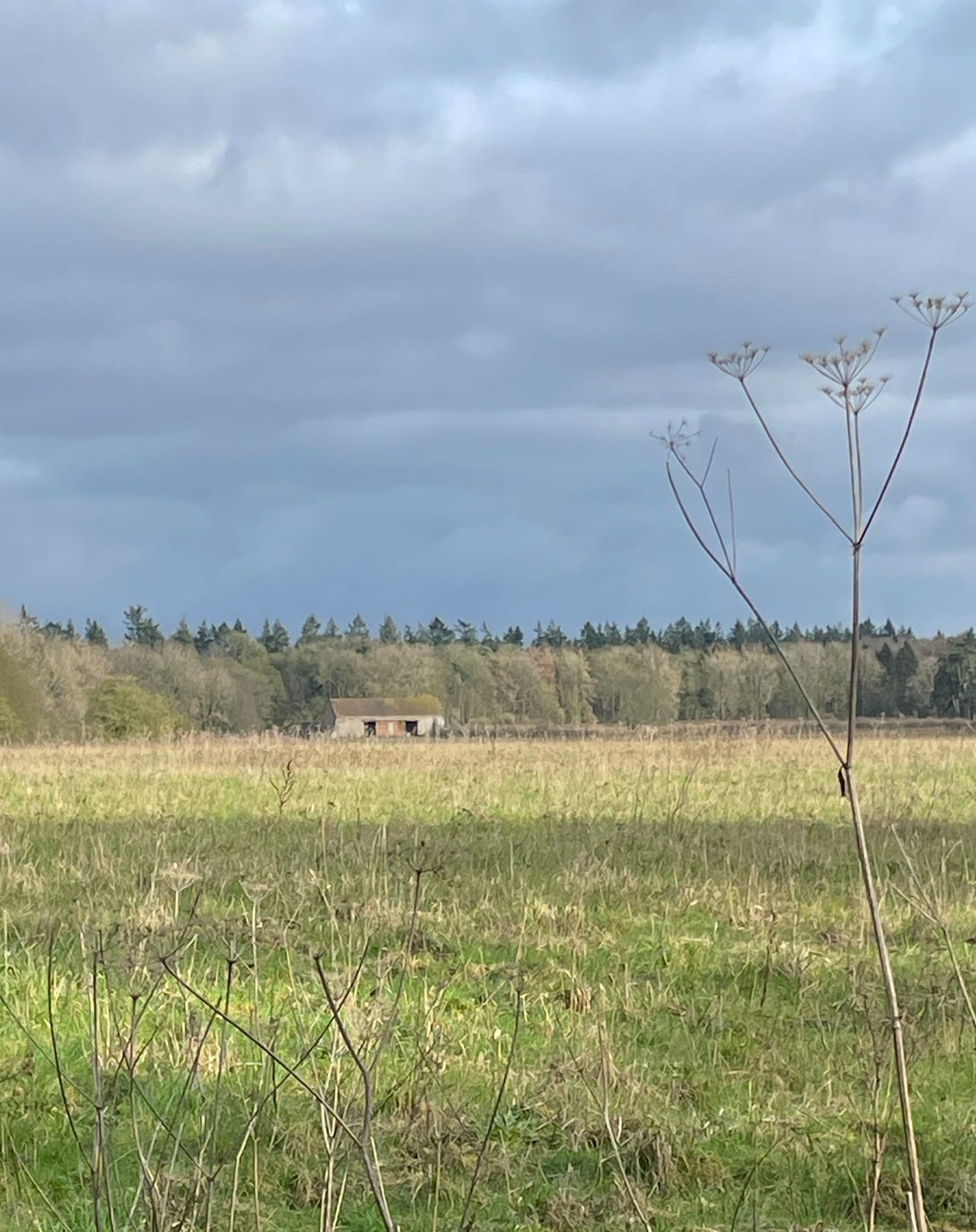
We come out into pasture, following a permissive path around its edge. A coal tit forages on a lichen-covered branch at the edge of the wood. Two buzzards circle, and just as we enter the next piece of woodland, a raven flies over, gronking. The ground underfoot is soft, but not too muddy. I can hear a nuthatch, somewhere over to my right.
A party of jays start their harsh screaming: whether it’s us they’re announcing or something else, I’ve no idea. The last part of the walk runs beside arable; there are often partridge here, or at least wood pigeon feeding, but not today.
At the house an email points out an omission in the courage story, a result of editing and an easy fix. Tomorrow I have editorial work to do on a thriller that bears far too close a resemblance to today’s headlines - and after that, it’s back to the second draft of An Unwise Prince. I’ve left it alone for a month; time to start overhauling it.
Just before I went to schedule this post, I checked today’s sightings on BirdGuides. A sand martin has been reported at Hicking Broad. The other side of the county, but still . . . not far as a sand martin flies. Guess I’ll be looking up more!
“The Enclosure Act of 1773 gave landowners the right to close off common land from the public. The areas that had once been free for ordinary people to use for farming, fishing, grazing livestock, gathering firewood, or hunting, were sectioned off. Commoners were barred from land that had been, by law, theirs.” https://www.idler.co.uk/article/we-must-protect-our-right-to-roam/
Wikipedia says St Nicholas is the patron saint of sailors, merchants, archers, repentant thieves, children, brewers, pawnbrokers, toymakers, unmarried people, and students. If my fictional world had saints (or any sort of organized religion), I think my character Kirt would be wearing a St Nicholas medal. He fits several of these categories.
https://wildkenhill.co.uk/ There is a public footpath through part of the property (although near the seawall it’s often (always?) very wet. As in submerged. There are very good views of the marsh from the seawall, too.